Sunday, January 31, 2010

Norilsk Nickel Metals Production Projection for 2010

Russia's Norilsk Nickel Mine (NILSY.PK) is the world's largest nickel mine, with its by-product palladium account for 45% of the world’s mine production.

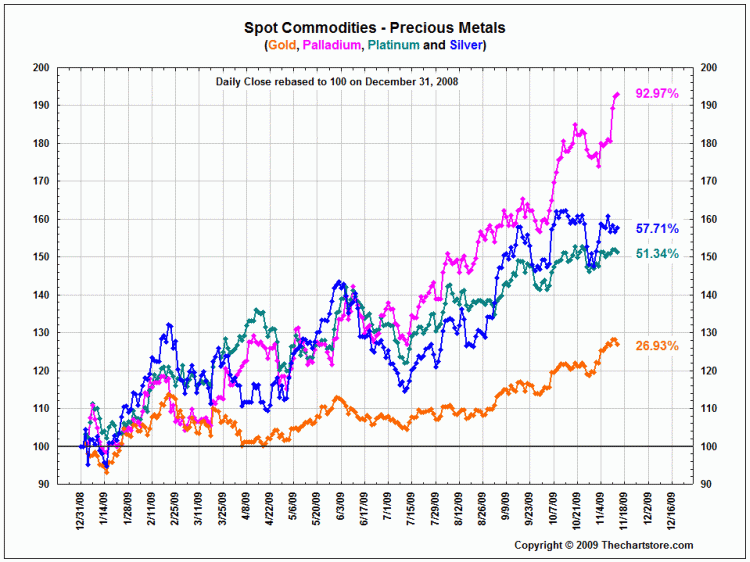
Recent termination of Russian government palladium stockpile sale, due to depletion of the stockpile, is just one of the reasons why palladium has extremely bullish supply/demand fundamentals, and why palladium performed the best among all four precious metals in 2009.

Reduction of palladium production from Norilsk Mine could further restraint the supply, and may prompt major industry users to panic hoard like in 2000/2001.

One must correctly project Norilsk Nickel's 2010 metals production, to have an accurate picture of global platinum and palladium supply/demand outlook for 2010.

Norilsk's Russian operation has two divisions, the Polar Division, which produces platinum and palladium as by-products, and the Kola Division, which contains only nickel and copper.

The Polar Division proven reserve mineral ore contents are as following:


Ore TypeNi (%)Cu (%)Pt (g/ton)Pd (g/ton)Cu/Ni Ratio
Rich2.86%3.98%1.497.041.392
Cuprous1.13%4.58%2.5710.804.053
Disseminated0.49%0.89%1.453.971.816


There are mainly two types of ores, as disseminated is insignificant:


  1. Rich type, which is rich in nickel but poor in copper, platinum and palladium content.

  2. Cuprous type, the opposite, poor in nickel, but rich in copper, platinum and palladium.


In the past I pointed out that Norilsk was switching to the rich nickel ore to cut cost and increase nickel revenue, or simply due to the geology structure of the ore body being mined.

The effect of the production switch is that for the same amount of nickel, much less copper, platinum and palladium will be produced, as I predicted.

The data in the past two years and Norilsk’s own projection for 2010 have confirmed my prediction. The ore type switch can be closely monitored by looking at the Copper/Nickel production ratio and see how it changes over time.

Here are the Norilsk Nickel Russian production (Polar + Kola Divisions) over the years, plus 2010 projections:


YearNi (tons)Cu (tons)Pt (troy oz)±%Pd (troy oz)±%Cu/Ni
2005243,000427,000751,0003,133,0001.757
2006244,000425,000752,000+0.13%3,164,000+0.99%1.742
2007234,454404,465727,000-3.32%3,049,000-3.63%1.725
2008232,302400,338632,000-13.1%2,702,000-11.4%1,723
2009232,813382,443636,000+0.63%2,676,000-0.96%1.643
2010*234,000363,000655,000+2.99%2,715,000+1.46%1.551


(* Based on Norilsk Nickel projection for 2010)

We are interested in palladium, so we want to see only the productions of the Polar Division. After subtracting the Kola Division, here are the numbers for the Polar Division:


YearNi (tons)Cu (tons)Pt (troy oz)±%Pd (troy oz)±%Cu/Ni
2005123,000361,000751,0003,133,0002.935
2006122,000351,000752,000+0.13%3,164,000+0.99%2.877
2007119,000338,000727,000-3.32%3,049,000-3.63%2.840
2008122,000339,000632,000-13.1%2,702,000-11.4%2.779
2009122,813321,443636,000+0.63%2,676,000-0.96%2.617
2010*124,000302,000655,000+2.99%2,715,000+1.46%2.435


(* Based on Norilsk Nickel projection for 2010)

As shown in the chart, nickel production is maintained pretty flat over the years. However the copper/nickel ratio consistently dropped. The drop of the Cu/Ni ratio accelerated since 2008 and continues to go significantly down in 2010 projections.

As a result, I predict Norilsk’s palladium production in 2010 will not raise slightly as projected by Norilsk Nickel itself, but rather should continue to drop significantly from 2009 level, commensurate with the drop of copper/nickel production ratio.

I am predicting a palladium production level at 2.55M ounces for 2010, and platinum at 600K ounces level.

Is it ridiculous that people should believe my prediction, rather than Norilsk’s own prediction? From early 2008 on, based on my observation of the ore type switch, I insisted on my prediction of Norilsk palladium production at 2.7M level for 2008.

But Norilsk re-iterated, in its Q1 production release, that it’s on target to reach 2008 palladium production level at 3.02M to 3.07M ounces. In the Q2, 2008 report they still insisted that previous full year projections were unchanged. In Q3 they did not revise annual guidance either. When the final result of 2008 came out to be 2.7M ounces, I was right, Norilsk Nickel was wrong. Why would they insist on a wrong and overly optimistic guidance, is beyond me.

The bullish case of the global palladium market now looks even better.

Investors in the world’s only primary palladium producers, Stillwater Mining (SWC) and North American Palladium (PAL), will stands to profit from the expected palladium price surge in 2010.

After falling for a continuous 8 days for a healthy correction from recent high, it’s now time to buy back these two stocks, SWC and PAL.

Data sources:
Norilsk Nickel Company Web Page
Norilsk Nickel Production Result Releases
Norilsk Nickel 2009 Production and Projection for 2010
Norilsk Nickel Mineral Reserves and Resources Statement
Norilsk Nickel Mining Operations

Full Disclosure: The author hoards physical precious metal palladium, and hold large positions in SWC and PAL. 95% of my 401K account is in SWC and PAL.

Thursday, January 28, 2010

Unwinding of Currency Swap = Looming US Dollar Crisis!

The Daily Gold blogger Harvey Organ reports that ECB and other Central Banks are terminating the currency swap with the US Federal Reserve Bank as of Feb. 1, 2010. How they are going to unwind the currency swap is something very interesting to watch. It could finally trigger the long expected US dollar crisis: Collapse of the US treasury market and the US dollar itself.

In a currency swap, two central banks print their own currency out of thin air and swap them in a zero interest loan according to the exchange rate. Then after a period of time, they return the loaned currency to each other. For example the FED will loan US dollars to Bank of England (BOE) while BOE loans British Pounds to the FED. Upon the end of currency swap agreement, they unwind the trade by the BOE returning the US dollar, and the FED returning the British Pounds.

The question is how they are going to be able to unwind? The total swap is believed to be as high as US$500B. Some say as high as US$2T. If the central banks merely locked up the cash in a vault, they could easily return the money. But that would defeat the whole purpose of currency swap. Instead of being locked up in a vault, the swapped currency must have been SPENT in some way. Then the question is how do they get the money back if it is already spent, sold out or otherwise given away?

For example I long suspected where did the British get the money to buy US treasuries over recent times? According to latest official data, UK's holdings of US treasuries was up $145.1B in 12 months, while China's holdings went up only $76.4B.

Where did the UK get the money to buy US treasuries? Unlike China which earns US dollar from its trade surplus against the USA, The UK has a huge trade deficit against the USA. It spend US$2 buying US goods for each US$1 it earns selling products to the USA. Where did they get the US dollars to purchase US treasuries? If it was not from trade balance, it must be from the give out by the FED, in the name of currency swap. It cost UK nothing to print British pounds and then exchange for the dollar, just like it costs the FED nothing to print the dollars.

In a sense, FED is secretly buying our own debts through foreign hands, via the currency swap agreements!!!! Now, how is the currency swap going to be unwinded? What magic are they going to pull this time, asn the BOE has already SPEND out the US dollar in buying US treasuries. It does NOT have the money to return to the FED.

Likewise, probably the FED does not have the money to return to BOE either. They must have spent out the British Pounds as well as other foreign currencies, in repeated attempts to sell foreign currency and buy US dollars, to support the dollar, in recent times.

It's going to be fun to watch how the unwinding can be done. If my speculation is right, BOE must sell its holding of US treasuries to raise US dollar to unwind the loan, and the FED must also need to sell dollar and buy British Pounds to unwind its loan as well. Both would be fatal blow to the value of US treasury and US dollar.

Time to run to precious metals as your financial safe haven. Don't run to euro, as the eurozone is crumbling down. Don't run to Japanese yen. Japan has an even worse debt problem. When Japan collases under its debt it must sell US treasuries to salvage its own currency, which will trigger a domino effect leading to the fall of the dollar. The only thing safe are precious metals and commodities.

But unlike most other precious metal bugs I will not tell you to run to gold, or silver. Every one talks about gold as if it is the only safe haven. When every one talks about one thing, be careful. The world is not in shortage of gold. The world has plenty of gold that could easily lasts a couple thousand years if we do not produce gold any more. Warren Buffet famously critized gold by saying that you dig out the metal from the ground, and then dig another hole to hold up, and have to pay armed guards to watch it, what for?

I am also questioning the wisdom of silver investment. Silver bugs have been calling for silver shortage for years. But I never see any solid data to back up the claim of shortage. If there is no shortage, if a precious metal's price is only supported by investment demand, then there is a problem because anything that is purely supported by investment demand, is by definition a bubble, the investment demand could easily turn into investment supply in an instance.

The only good precious metal investment, must be one which is based on REAL industrial shortage, not by the hypothetical investment demand. If there is an industrial shortage, the price MUST go up regardless what investors believe. And price movement due to real shortage, on the other hand, can create solid and reliable investment demand. Such precious metals will provide the best performance way much better than gold.

The only two precious metals I see solid data to support a supply shortage case, are platinum and palladium. Of course my favorite is PALLADIUM. My most favorite mining stocks are Stllwater Mining (SWC) and North American Palladium (PAL), the only primary palladium producers. Russia's Norilsk Nickel (NILSY.PK) is world's largest palladium but they are mainly a nickel producer. South Africa's Anglo Platinum (AGPPY.PK) and Impala Platinum (IMPUY.PK) produces by-product palladium. Watching Platinum Today on related PGM metals news, and KITCO for price movements.


The parabolic price rally of palladium in the past one year, a performance that is far better than gold, silver and platinum, has vindicated my conviction on a palladium bull case.

Why palladium? FOUR things make palladium extremely bullish:

  • 1. Termination of Russian government palladium stockpile sale, due to stockpile depletion.

  • 2. Looming South African electricity crisis could strike again any time, just like two years ago.

  • 3. Launch of ETF Securities physical palladium fund (PALL) in the US market.

  • 4. Long term potential of palladium used in Cold Fusion, make it a must have strategic metal.


  • I have discussed these points in many of my past articles which I will not repeat. I merely needs to point out that Impala Platinum's PGM Supply Demand data confirms dramatic reduction in Russian palladium supply, as the stockpile sale has ended. There is now a big strictural deficit. Read more detailed discussions on GIM forums.

    I do not have to cover the recent launch of ETFS platinum and palladium funds, either.You can see the powerful price surge of palladium recently, and read what fellow SA contributors have to say:

    Why Gold ETFs Should Be Afraid of Platinum Cousins
    Platinum and Palladium ETFs: Dare They Outshine Gold?
    Platinum, Palladium ETFs Are a Home Run
    Pent-Up Demand Is Behind Platinum Fund's Success
    New ETFs Off to Roaring Start
    Don’t Blame Platinum, Palladium ETFs

      Sadly, even though people have caught attention to platinum and palladium. There has been absolutely NO mentioning of the end of the Russian palladium stockpile sale, and how palladium rallied from $300 to $1100 in 2000 merely because of a FALSE rumor related to the stockpile sale. Nobody mentioned the South African electricity crisis either, even it triggered quite a rally in PGM prices in early 2008, and another South African electricity crisis is looming again in the near future. Please read the background discussions.

      And yet most people don't even know about platinum and palladium. All they know is gold gold gold, silver silver silver.

      Let them have gold. I want to have palladium. And I can not own enough stocks of SWC and PAL. I have been predicting and advocating for a super bullish palladium rally for almost two years. No one paid attention until it really happens.

      But this is just the start! The real fun will begin when auto makers realize what's going on in Russia and South Africa, and start to panic hoard. If it were not for the foolishness of major industrial user like TOYOTA(TM), GM and FORD (F), rhodium would never see gigantic price swings from $300 to $11000. Shouldn't industrial users acquire and keep a plentifully large stockpile when rhodium was at $300, so they do not need to pay $11000 an ounce a few years later? They never learn.


      Full Disclosure: The author is heavily invested in palladium mining stocks SWC and PAL, and own PALL. The author owns silver mining stocks like CDE, SSRI, PAAS but have no interest in ETF funds GLD and SLV, as I do not trust their gold and silver holdings.

      Saturday, December 5, 2009

      Hot Money, Hot Commodities and the US Dollar Carry Trade Part 3

      In part one of the article, I argued why the collapse of the US dollar is inevitable and commodities are the only safe haven in the event of currency collapse; In part two of the article I begin to demystify some mis-conceptions about commodities investment. Some times even Jim Rogers could be wrong. I specifically cited the example of the UNG natural gas fund.

      In this part three, I will elaborate more on what are the correct approaches for commodities investment, and what is the best commodity to invest in. I am going to discuss the things that Jim Rogers was wrong about.

      I can not emphasize this enough: When you invest in something, you should always ask the question WHO PAYS FOR YOUR PROFIT. You can't create money out of thin air. Some one has to pay you for you to make a profit. If you can not figure out who pays for your profit, then your investment thesis has a problem.

      In the market, the majority of people must be the losers so as to allow a few people in the minority to make obscene amount of profits. That's how the world works. Always think for yourself, do not let other people do your thinking for you. I have high respect for Jim Cramer who I think is a smart guy. Unfortunately too big a crowd gathered around him, so that the biggest crowd must necessarily be the biggest crowd of fools and losers, by definition. That's not Jim Cramer's fault, but his success, as an entertainer.

      Warren Buffet is the buy-and-hold-forever type of investor. Who pays Warren Buffet if he nevr sells? The companies he own keep operating profitable businesses to genenate fortune for him.

      Who pays the day traders who buy and sell equities in short periods? It's got to be fellow day traders. So day trading is nothing but gambling, a zero sum game with 50/50 winning and losing odds. In recorded history no one becomes a billionaire through day trading.

      Who pays you when you invest in something for long term? The rest of the investor community, Mr. market pays you. All long term profitable investments requres two things:

      1. You need to have the wisdom to recognize the long term value of your investment.
      2. The rest of the world must disagree with you, so you can buy your investment cheap.

      I must particularly emphasize the second point. For your investment thesis to be correct, people must disagree with you. They will ridicule you, curse you, calling you all sorts of names. If people laughed at you, don't be discouraged and don't get angry. Instead take their laugh as a compliment and take comfort in the fact that most people disagree with you, so you are in the minority, so you are probably right.

      But you still need to make sure you are right in the first place. This requires hard work doing your due diligence research. This also requires that there need to be some people, who, after spending time doing their own due diligence, no longer laugh at you and start to agree with you. That is important. If every one in the world laughs at you, then you are an idiot. If 99% of people laugh at you but 1% do take you seriously, then it says you are a genius and the world is a fool.

      All the successful investors receive more than enough of their fair share of being laughed at, in the early stages of their investment careers, including Warren Buffet and Jim Rogers. But no one laughs at Warren Buffet any more. Every one takes him seriously now. That's his problem. Anything he wants to buy, it leaks out before he could buy enough so he ended up paying more. Any time he wants to sell, people beat him before he could sell much. When you have a big crowd around you, it makes a billionaire very hard to make his next move.

      Jim Rogers also have a big fan group, so even though he deserves high respect from me, I will take him with a few grains of salt. His pitch on agriculture commodities, his best favor, for example, I think is flawed. Let me discuss why. hope some one can pass this note to Jim Rogers himself, so he knows why he is wrong, or argues with me why he is still right.

      Jim noted that every one needs to eat, and there is limited land resource to produce all the food people need to eat. That is a fact. But that is a fact known by every one already, and it is a true fact for millions of years already. The best invest ideas always come from facts that are recent news, and that few people know, not from something every one already know for a long time. So this immediately rings an alarming bell on Jim's agriculture commodity thesis.

      Jim failed to notice that the threshold for demand destruction is low for food, and hence it caps the value appreciation potential of food. Poor peoplein poor countries already dedicate 75% to 90% of their disposable income on food. How are they going to pay more? There is not much room to go from spending 90% of income to spending 100%. People will just have to eat less and eat what their income can afford them. So this reduces demand and caps the price appreciation. In fiat currency term, the price can still go up a lot. But in purchase power term, there is virtually no room for growth.

      Consider that no one can spend more than 100% of disposable income, and that food expenses are already the biggest percentage of people's spending, I would say that in terms of purchase power, agriculture products are probably the WORST of commodity investments, not the best.

      Applying the same thinking, I think Jim's another pitch is a great one: Water. Water is more important than food to sustain human lifes. How much an average family spends on water, in terms of percentage of disposable income? I am paying roughly $1.50 for one unit, about 97 gallons. That's only 1.5 cents a gallon. So there is a lot of appreciation potential. If there is water shortage, when water bills hit 25% of a family's spendings, people will start to use less while each gallon will become more expensive. Pushing the theoretical limit, you can probably survive reasonably well on just two gallons of water per day and the water will costs a family of four about $1000 per month. That's roughly $4 per gallon water. So that's a lot of appreciation potential going from 1.5 cents to $4 per gallon of water. That price target is actually realistic, as people in some Arab country are already paying more per gallon for water, than for gasoline!!!

      Water is just an example to stimulate thinking. Investing in water is tough. How do you store water at low cost for long time without spoil it, besides there is no shortage of water on earth. There is only a shortage of water purification treatments and transportation. Maybe investing $1000 or so for a secured drinking water supply, is a wise investment for your family.

      I consider precious metals as commodities in a broad sense. Many gold bugs consider gold as a sacret cow, different from other commodities. I disagree. Gold or any precious metal is simply a metal that is precious. Nothing more and nothing less. Sacret cow only exists in religions.

      What's the best commodity to invest in? As I discussed in my last article, the only sensible to invest in a commodity is to either hoard the physical stuff, or invest in the companies that produce the stuff. So an ideal commodity to invest in should be easy to store, and has the largest price appreciation potential:
      1. It should be compact and easy to store, and remain safe and stable for long term. This immediately rules out any thing gaseous or liquid, because they are hard to store.

      2. It should be price inelastic on the demand side. That means price can be driven up to very high level, and the industry consumers can still afford it. This immediately rules out food products and base metals that are used in bulk quantities, like steel, copper and aluminum.

      3. It should also be price inelastic on the supply side, that means it should probably be a by-product. Most producers will not bother to increase the production of their main product just to produce more by-product and marginally increase their by-product profits.

      Once you apply these rules, there are not many commodities that can qualify as the best commodities investment. Three metals meet all the requirements: Palladium, silver and tellurium. No. 46, 47 and 52 on the periodic table.

      Silver is almost as widely known as gold, and more widely used as money than gold, throughout human history. People in China and other Asian countries love silver better than gold. Recent news from China indicate that silver investment is red hot, while the gold market is flat. Jim Rogers himself encourages the Chinese to buy silver and palladium, rather than gold.

      Over 70% of global silver supply is produced as a base metal by-product, only 30% is produced from primary silver mines. So silver can be classified as a by-product metal. On the demand side, silver is price inelastic. Silver is widely used in the electronics industry, but so little silver is used in individual components, that the cost is never a concern. On the jewelry side, material cost ofsilver is a very small percentage of total cost of most silver jewelries, so at current price level, silver jewelries are price inelastic as well.

      I like silver as a storage of wealth. But I like palladium much better, as an investment. For decades, there is a large structural deficit in global palladium supply. The global palladium deficit was only filled in by the annual Russian Government paladium stockpile sale, which is about 1 to 2 million ounces a year. Global mine production is about 6.5 million ounces per year while consumption well exceed 8 million ounces per year. Read Platinum 2009 Interim Review to get an idea of platinum/palladium supply/demand numbers.

      Russia has the world's largest nickel mine, Norilsk Nickel (Nilsy.PK), which is also the world's largest palladium producer, since they produce palladium as a by-product. The Russian government accumulated the excess palladium production during the Soviet Era in their strategic metals stockpile. You must read the 2003 report by Alan Williamson to understand the Russian palladium stockpile and how its size could be estimated. A false rumor regarding the Russian palladium stockpile trigger the palladium price spike of 2000/2001.

      Many metals analysts have been speculating that this Russian palladium stockpile is near depletion. If that is the case, it will be a paradigm shift event which could send the metal price sky high, far exceeding the 2000/2001 price peak of palladium price.

      Two recent news items confirms that the Russian palladium stockpile has indeed depleted. One is on August 31, 09, another is on October 15, 09. So far, this news has not caused much attention and has not resulted in explosive palladium rally yet. My favorite palladium mines, SWC and PAL, have moved up in share price. But they are still far from the heights where I expect to see them to reach.

      But looking at the performance of palladium price in the past year, how could any one still complain? As fellow SA contributor John Lounsbury also noticed, Palladium already did far better than platinum, silver and gold in the past 12 months. I just wish more people learn the story of the depleting Russian palladium stockpile.

      Many years ago, Warren Buffett correctly pointed out that Mr. Market is a fool. My own experience tells me that I could never underestimate the foolishness of Mr. Market, or the stupidness of the world. You only need to look at the global warming hysteric fiasco.

      The foolishness of the general investor community can be best reflected in the tellurium story. Two years ago I advocated for hoarding physical tellurium and predicted that the business of First Solar (FSLR) is not going any where, as they could be suffocated by a global tellurium shortage brought about due to the emerging new applications of tellurium based electronic devices, like phase-change memory. How many people listened and believed me? More people in the world understand Einstein's Relativity Theory, then people who understand tellurium supply and demand! Now Numonrx was able to make multi-layer phase-change-memory chips. This is a paradigm shift in the electronics industry. As advanced as the modern microelectronics industry is, they were never able to produce a multi-layer computer chip. It's going to be huge for tellurium and a gigantic jackpot for the tellurium investors.

      But for now, people still fight hand over fist to buy FSLR stocks, believing that First Solar can grow its business unlimited. Some investors actually believed that tellurium can be extracted from sewages, because I told them most tellurium is extracted from the slime mud produced during copper electrolysis production. Yeah right! Just don't do it at home and don't dig out the sewage pipe in your toilet. I assure you there is no tellurium to be found.

      Full Disclosure: The author hoards physical tellurium, physical palladium, and has large long positions in SWC and PAL, as well as silver mining stocks SSRI, PAAS and CDE. The author no longer holds position in UNG and has no short or long position in FSLR. The author holds other positions unrelated to the discussion in this article.

      Wednesday, October 28, 2009

      Hot Money, Hot Commodities and the US Dollar Carry Trade Part 2

      In the last part of the article I discussed the reason why the collapse of the US dollar is all but inevitable, but the US economy itself will be strong enough to survive. Let me say it again, collapse of the US dollar does not equal to collapse of the US economy. If the dollar becomes worthless, Microsoft (MSFT) or Intel can sell their hardware or software products for gold or coins. They can still manage to make a profit, because the world still want their products.

      How do investors protect themselves during a currency collapse?

      First, the majority of investors and the majority of average American people will be wiped out financially. That is a FACT of mathematical statistics when a country's currency collapses. Majority of people will be wiped out, but a selective few in the minority will be able to rip huge profit from the crisis. If you want to protect yourself, you can not be with the majority. You must be with the minority group of people. Do NOT let other people do the thinking for you.

      So are you listening to the most popular economic analyst or the most popular financial TV host? If you do, you are in danger because you are together with the biggest group of fools! You find safety when you are forced to jump from a big boat to a small boat, not the other way around. Just ask Titanic survivors how they survived. They jumped onto very small boats instead of wait for something bigger than Titanic to come to their resque. Safe havens must necessarily be small and can not accomodate too many people.

      Commodities are the only safe haven. As Jim Rogers said, commodities are the only asset class with fundamentals impaired, but improved. But there are lots of myths in the commodity investments. Even Jim Rogers himself had also spreaded some incorrect myths regarding commodities investment. Most people do not know how to invest in commodities because they have not even once laid their fingers on any physical commodity. The only thing they have ever touches is a computer keyboard and mouse. A computer and a brokage account is all you need to invest in commodities, right? Wrong!

      The door for commodities investment is extremely narrow. Let me tell you a small story. I am a big fan of tellurium investment and hoard actual physical tellurium. The price low of tellurium a few years ago was about $10 per pound, recent high was about $140 per pound. I predicted tellurium price could go to multiples of gold price once phase change memory goes into wide application. Almost every one laughed at me. Some, a few, did take me up seriously but they ask me NOT where to buy the physical tellurium, but rather, where to buy paper future contracts of tellurium, or what mining stock they can buy. When they hear that these two investment instruments do not exist for palladium, they left with disappointment. Most market traders do not know what to do with physical asset. They would rather prefer the convenience of pushing a computer button to instantly buy and sell something. Till this day, I think there are far fewer tellurium investors than people who understand Einstein's Relativity.

      I believe that pure computer trading is the wrong way to invest in commodities. To invest in commodities you HAVE to get your hands dirty and lay your hands on the physical things. Let me explain using the example of the United States Natural Gas (UNG) fund.

      Recent dismay performance of UNG gave me pause to think about how to invest in commodities. Natural gas spot price recovered from the low of about $1.84 to now nearly $5, almost a triple, but the share price of UNG still struggles around $10. Why is UNG not tracking the price of the natural gas itself? The simple answer is it's killed by contango. But there is a deeper reason.

      UNG does not hold the physical natural gas. Instead they hold futures contracts. In theory, when natural gas price goes up, the asset value of these futures contract also go up. But in reality such methodology is flawed. You are holding future contracts that you never intend to take delivery. So near the expiration of the future contracts, you are forced to sell them, at any low price. Mean while you must buy the next month's future contracts, at whatever high price they are offered. As a result, in each round of the roll-over, UNG loses positions and loses money.

      More over, the more investors are interested in UNG, the worse a situation UNG finds itself in. (Remember, the bigger crowd is always the loser!!!) During each roll-over, UNG could be purchasing more future contracts than producers have products available to write those contracts, hence it bids up price on the buying end. Then it turn around to sell the future contracts to industry consumers, it has more to sell than the industry consumers can buy, hence it pushes the price down on the selling end. How could you not lose money? It's like two mechants compete with each other. They bid the price up purchasing produces from the same farm, and then cut each other's throat to sell to customers at super low prices. Both lose.

      Since UNG purchases future contracts that it never intend to take delivery, conceiveably on the other end of trade could be some one who write future contracts that he never intended to deliver, as he does not have the product to deliver. As no delivery is ever demanded, such paper future contracts can be created out of thing air in unlimited quantity to "meet" investment demand. Basically one side provides empty promises of supply, the other side provides false demand that never materializes. This is nothing but a zero sum game. One party's loss is exactly the other party's gain.

      Therefore it is flawed to believe that trading future contracts is investing in cmmodities. It is NOT. Future contracts are derivatives with which the two sides gamble against each other. The commodity may be bullish, but you have a 50/50 chance to beat your counter party to win.

      If you are interested in commodity investment, do NOT buy paper derivatives, whose supply is unlimited. Buy the physical thing, which is limited, and take delivery.

      Now from a fundamental point of view, every investor needs to ask: If I invest in something and I gain, WHO pays for my profit? You are not the FED so you can't create money out of thin air. If you make a profit, then some one or something must be paying you that profit. If you buy a stock and make money, it's because the business of the company generates revenue and income, or because another investor pays you more than your original cost. I invested in physical tellurium because I know some years down the line, First Solar (FSLR) or Intel (INTC) will pay me gold price to buy my tellurium hoard.

      But who pays for your profit when you invest in a commodity? Do your fellow investors pay you? If so it sounds like a Ponzi scheme. It has to be industry users of the commodity that pays you the profit. The only way for you to get paid by industry users, is for you to participate in the supply and demand of the commodity, for you to become a physical demand and then a physical supply. That means the only sensible way of investing in commodities, is for you to take physical delivery, hold for long term, until the price is higher, then you sell to the industry users.

      Once again, The door for commodities investment is extremely narrow. Most of supply and demand have been directly negotiated between industry suppliers and industry users, leaving you no opportunity to participate in the market. Natural gas is a good example. The opportunity to store natural gas is virtually non-existant for outsider investors. Any gain or loss is likely directly settles between industry suppliers and users, and that leaves investors out of the natural gas business and unable to rip profit from the price appreciation.

      So if you think investing in commodities is as easy as pushing a computer button, and you do not have to deal with the huzzle of buying/selling, transporting and storing the actual physical stuff. Please pause and think again. WHO PAYS YOUR PROFIT if you are not taking all the huzzles?

      For this reason I am inheritly suspicious about all sorts of commodity ETFs, like GLD and SLV. Particularly SLV. Read my previous Instablog regarding some red flags in the SLV fund. What troubles me is that these nice folks help you to take care of all the sweating and laboring to handle the physical stuff, and allow you comfortably making profit sitting in front of a computer. It just sounds too good to be true.

      (to be continued...)

      Full Disclosure: The author is long precious metal palladium and silver, hold big positions in palladium mines SWC and PAL, as well as SSRI and CDE. I hold shipping stocks like EXM, EGLE, TBSI, DRYS, and small positions in natural gas fund UNG. I short the US dollar by holding some long positions in margin brokage account.

      Monday, October 26, 2009

      Hot Money, Hot Commodities and the US Dollar Carry Trade Part 1

      The collapse of the US dollar has passed the point of no return. An abrupt US currency collapse is now very possible. I hope we can see a gradual and orderly decline of the US dollar. But this best case scenario, as Peter Schiff hoped for, is now not likely. Peter Schiff still believes that there is still something that the FED or the US Government can do, to save the dollar. I disagree with him. Peter Schiff obviously does not understand how free market economy works, nor does Ron Paul, nor does Roubini. Jim Rogers is one of the few who understands and how free market capitalism works, and practices it by moving his family and assets to Asia. (President Obama: You still have two jobs to do: Buy the first lady an Iridium ring; and bring Jim Rogers home using Air Force One. That's all you need to have a strong family, a strong presidency and a strong nation. No kidding!)

      This brings to me the Hot Money problem that China and other countries face. China has a gigantic foreign currency reserve that is composed mostly of US dollar assets, amid a looming prospect of ever falling dollar; China doesn't want to accumulate more dollars. But hot money keeps flowing in from the outside, smuggled in through Hong Kong, forcing China to print more RMB yuans to absorb the inflow of US dollars. China is not alone. Brazil recently slapped a 2% tax on foreign capital entering the nation's stock and exchange market. Australia is worried, too. Read how China's Commodity Carry Trade strategy of divesting the dollar: part 1 and part 2.

      The Hot Money "problem" that China and the world worry about is actually free market principles working at their best. Basic Darwinism dictates that market capital will always go where it wants to go, not where the governments want it to go. Capital wants to get away from the soil that suffocates its growth, and move to fertile lands where it can thrive. Hot money flows out of the developed nations and into developing nations and nations with rich natural resources, because that's where opportunities of grow are.

      Government interventions to stop the free flow of money are futile, fruitless and counter-productive; Government interventions to manipulate currencies and commodity prices are equally futile, fruitless, and counter-productive. Free market capitalism always works.

      Recently Julian Robert thinks that the US faces Armageddon if the Chinese or Japanese stop buying the US debts, and that both countries maybe forced to sell US debts, due to domestic needs. He was right, except for the Norwegian part. The journalist asked: All the rich Norwegians have moved their money out of the country, so why do you invest there?

      Good question! Capital money has its own mind. It wants to escape from hostile environments, and move to lands where it can grow and prosper. Rich Norwegians move their money out of the country because they are taxed to death. There are places where the taxation is less and the opportunity to grow is bigger. Again, government interventions are futile. China's effort to crack down on hot money inflow hardly made a dent. Equally futile was US government's tax cracking down on rich Americans who have foreign bank accounts. Such crack down is futile. If Americans want to move their money out of the country, there are plenty of ways to do it. Voting with feet is a more powerful than vote with a paper ballot. But if that's not enough, one could cast the ultimate vote with the US passport as the ballot ticket, at an overseas US consulate.

      Instead of the futile crack down, the US government needs to exam itself in retrospect and ask why Americans are moving money to foreign soil, and what it can do to attract foreign money to come back to US soil. This is the key: When the money is leaving the US soil for foreign land, so are the job opportunities, so are our best investors, our best innovators and our best technical professionals, and so are our nation's future. So what do we have left? A dying US dollar and millions of jobless and hopeless hungry and angry people either sit at home waiting for the government to feed them, or else take to the street.

      Peter Schiff believes that to save the dollar, all we need is the FED dramatically hike up the rate, stop money printing, and the US government massively cut spending and raise tax. The basic ideas are right. But if he believes those are realistic or possible, he really doesn't understand how free market works. What works is not what a government does, but rather what a government does NOT do. In China's history, every dynasty that prospered was only because the emperor taxed little and asserted little control of the society.

      Great Chinese philosopher Lao Tzu said that governing a great nation is like cooking a small delicacy: You cook just enough so all the original flavors are preserved. If you over-cook then what comes out is anything but a delicacy. Sure America is a melting pot. But President Obama is cooking this melting pot way too hard that not only there is lots of capital spill over, but the melting pot itself is melting!!! Just ask the first lady how to cook!

      Peter Schiff believes the FED can still dramatically hike up the rate and stop money printing, and the government can dramatically cut spending and hike tax, in order to save the US dollar. If it was that easy, if a government has the power to salvage its own currency, then why didn't Zimbabwe's President Mugabe do it? Did he not raise interest rate of Z$ dramatically? He has the money printer so he can afford to pay any high interest, right? Higher interest is meaningless if the principal itself, the value of one dollar drops even faster. The FED stops printing money? Who is going to buy our mountains of new issue US treasury bonds, if the FED doesn't print money out of thin air to buy our own debt?

      How about the US government dramatically cut spending and hike up tax rate? You can't collect more tax from business that are not profitable, and hence has no tax to pay. Higher tax will force the profitable businesses to move to overseas, reducing, instead of increasing tax revenue. Cut spending? Which part do we cut? I think we should first cut the all the bailouts to the big banks and let them fail? But then do we want a nationwide bank runs and bank failures, and watch FDIC to go bankrupt? How about cut welfare and cut unemployment benefits. Then all the desperate people deprived of livelihoods probably will siege the White House, bringing their empty pots alone, banging and singing, until the resident has to get away on a helicopter.

      Let's face reality, Mr. Peter Schiff. When you see the melting pot itself is melting and there's lots of boiling spill over, you are going to tell people that we can still have a great dinner if we do the right thing? NO! You should honestly tell the people that there is no more delicacy for dinner. The people HAVE to go to sleep with an empty stomach. What we can still do, is not to try save the delicacy, but to save the pot, so we can still cook a good meal tomorrow. Of course, Peter, you can not win votes by telling people they will be hungry. But that's the reality.

      There is no salvation of the US dollar. But the US economy itself can survive and prosper. There are certain elements of the US economy, no, not the banks, not the Wall Street, but the real productive sections of the US economy, that will survive and prosper. American farmers will continue to produce food that the world needs. Intel (INTC), AMD and Microsoft (MSFT) will continue to produce computer hardware and software that the world needs. Catepillar (CAT) will continue to produce great construction machineries that China and the rest of the world wants. My most favorite mining company, Montana's Stillwater Mining Company (SWC), one of the world's only two primary palladium producers, will continue to produce palladium because the rest of the world still needs palladium, even though the bankrupt GM doesn't want to buy from SWC. Not to mention we have so many of America's world class science and technology products that the world needs from us. Not to mention our best treasure, the US constitution, one of the most beautiful constitution and the envy of the world's poor, tired, suppressed and desperate people.

      Yes, the US dollar, a fiat currency, will collapse; No, the US economy itself will not collapse. A good historical precedence is hyperinflation Weimar Germany did not destroy Germany: It still had enough economic and military power to allow Hitler to launch World War Two.

      Yes, the US Federal government is bankrupt, as is the FED; But No, the American nation, as well as individual states, will not go bankrupt. California will not go bankrupt. It has a constitution mandated balanced budget until recent years, and it is trying very hard to return to balanced budget, amid the difficult environment of tax revenue short fall and spending needs. It's heart breaking to see people start to talk about the possibility of session of individual states from the nation. But unless the federal government realize its own limit, and live within its limit, I think as we raise to the USSA we could well become the next USSR one day. The US government itself needs a bailout, not just the dollar.

      I will discuss in the next part of this article how individual investors can protect themselves and make profit from the downfall of the dollar. Specifically I will talk about equities, commodities and US dollar carry trades, as well as how to use leverage to increase your gain.

      Full Disclosure: The author is long precious metal palladium and silver, hold big positions in palladium mines SWC and PAL, as well as SSRI and CDE. I hold shipping stocks like EXM, EGLE, TBSI, DRYS, and natural gas fund UNG. I short the US dollar by holding some long positions in margin brokage account.

      Sunday, July 12, 2009

      The Inflation/Deflation Debate and China's Commodity Carry Trade

      The inflation vs. deflation debate is heated up again. The debate looks far from being settled, even among professional investors. The average Joes are probably more clueless. This may be the single most important debate in the investment world.

      Jim Rogers, Peter Schiff, James Sinclair, Gerald Celente, Marc Faber and Congressman Ron Paul are on the inflation camp. The argument is simple: As the US government racks up trillion dollars of deficit spending, the money can come from neither raising tax, nor borrowing. So the only way out is print money out of thin air. In history, any time a government chooses to solve its fiscal problem through massive money printing, it always leads to hyper-inflation at the end. So that is going to happen. It might be postponed a bit but can not be avoided.

      But I will not immediately dismiss the arguments from the deflation camp, either. Well known people on the deflation camp includes Mike Shedlock (MISH), Nouriel Roubini, and market ticker Karl Denninger. They present three strong arguments for deflation:

      1. Credits are destroyed in the ongoing de-leveraging process. Credits are circulated as money so the destruction of credit means less liquidity in the system.

      2. Although the government is massively printing money, most of the newly printed money is just hoarded away in the vaults of banks and do not enter circulation.

      3. Where is the inflation today? It's no where to be found!
      Debunking the second argument is simple. Banks keep a high reserve because they are highly leveraged and they fear a bank run. If banks hoard cash instead of extend consumer credits, people will have to withdraw cash so they have the money to spend. Such a bank de-leveraging process could escalade into a bank run, resulting in the destruction of the banks and massive release of cash into the general circulation.

      De-leveraging of the financial derivatives bubble does not cause deflation. Look at the history of Dutch Tulip Mania and the subsequent collapse. Did it lead to price inflation and deflation of things unrelated to tulips? Of course it didn't. The Dutch grocery stores never took a flower as a payment for milk and bread. Can I use a credit default swap to pay for milk and bread today? I can't. Inflation is a currency phenomenon. It has nothing to do with leverage.

      De-leveraging is the process that people abandon paper assets due to counter party risks, and turn towards physical assets with no such risk. Physical assets have intrinsic values: the marginal costs to replace them and maintain an adequate supply. So in the de-leveraging process, paper assets will lose value, and physical assets will gain value. The US dollar is a paper asset. The dollar is leveraged on the full faith and credit of the US government on its ability to pay off its huge amount of debts, which frankly does not look good at all.

      The world knows the US dollar is going down. Chinese students laughed loudly when Tim Geithner told them China's US dollar assets are "very safe". Many very rich and successful Americans know the dollar is going down. People like Jim Rogers are moving their assets out of the US dollars and into China and other places. No wonder the US government is cracking down on Swiss Accounts owned by Americans.

      So here is your answer where is the inflation. Blame it on guys like Jim Rogers are selling their US assets! Jim Rogers is a billionaire. He sold his house in New York, therefore New York real estate collapsed. He sold his furniture, sofas and tables and chairs, so that brings the furniture prices down. He sold his US stocks so the US equity market is down. He sold his stuff for US dollars, and bring his dollars away from the US soil, and into China. Jim Rogers drains liquidity from the US market, thus prices of everything drop :-) Speaking seriously: This is an ongoing BANKRUPTCY LIQUIDATION SALE, not a deflation. The low prices will not last.

      I told you that is exactly what happened, in my last article. Liquidity is drained from the US market because smart capitals are escaping from US soil to look for opportunities in places like China. This is a huge liquidity drain from the US. But it also causes headache for the Chinese. They need to deal with all the "hot money", the US dollars flooded into China to be exchanged into Chinese Yuan, as speculators are betting on Yuan appreciation over the dollar.

      In other words, currency speculators are EXPORTING our inflation to China by draining the liquidity from the US and bringing hot money to China.

      How China handles the massive inflow of hot money? China simply print their own money to soak up all the inflowing US dollars. It costs them nothing to print the Yuan to buy the dollars, and they can spend all the dollars to purchase physical assets and raw materials around the world. This is the Commodity Carry Trade they are playing, very successfully.

      Few people in the west recognize China's real strategy. They thought it is impossible for China to sell the dollar and exchange it into euro or yen. Why would China sell one paper just to exchange for another paper? They thought China's recent commodities buying spree is to merely boost price to help domestic producers, or to stockpile for strategic safety. But China's buying of aluminum, a material that China has plenty, signals that it goes far beyond strategic hoarding. Commodities ARE China's new foreign exchange reserves. China is not selling the dollars, China is SPENDING the dollars.

      With continued inflow of US dollars, and with China's own money printers running at high speed, China has plenty of money to spend and continue the buying spree. With Yuan tightly pegged to the dollar, this game can continue indefinitely until currency speculators stop sending the dollars to China. Then the US will go from being the largest exporter to the largest importer of inflation, over night! All the dollars will fight their way back home at once. Goods and raw materials will flow out of the USA, until this land is ripped barren! I predict many people will be voting with their feet, before the nightmare scenery occurs.

      The currency speculators did the wrong thing selling dollars buy the Yuan. The dollar is going down, but so will the Chinese Yuan. Investors should go to physical commodities, not Yuan or any foreign fiat paper money.

      Some Chinese already realize that the Yuan is losing purchase power. In recent months, there was a SUDDEN turn up in real estate markets in major cities in China. The housing slump turned into red hot housing boom, literally over-night, caught many people in a big surprise.

      Unless you read news in Chinese, you might think I was telling a fairy tale. But it is absolutely true. There is a sudden housing boom; an auto sales boom; a boom in bank loans. Mean while China could NOT sell its own treasury bonds. What does that tell you? China could not borrow a mere Y28 billion Yuan (US$7B) from its own people. Why would China be able or willing to extend another trillion dollars of credit to the US government?

      Jim Rogers is absolutely right that commodity is the only asset class whose fundamentals have not been impaired, but improved. One of the best sectors to play the Chinese commodity buying spree is dry bulk shipping, as China's global buying spree is far from over.

      Stocks in dry bulk shipping include the follow names:
      EXM, EGLE, TBSI, DRYS, GNK, DSX, NM, OCNF and SBLK.

      There is a shipping ETF called SEA. Do your own due diligence on specific positions.

      Raw materials that China does not produce, but are critically important to China's economy, are the best commodities to buy. This includes platinum group metals, platinum and palladium; aviation metal titanium; battery technology metal cobalt. My best favorite is the palladium metal, and palladium mining plays: Stillwater Mining (SWC) and North American Palladium (PAL). Recently Andrew Snyder published an article pitching palladium as a critical metal for China, and SWC with a potential of 1,389% gain, without naming the names! I am not sure any one knows what China's next big purchase is. But it is a fact that palladium is one of the critical strategic metals that any modern country must stockpile. Look at TIE as a titanium play, and OMG as for cobalt play. I also recommend buying physical cobalt.

      If you are interested in rare and strategically important metals, then follow Jack Lifton, a regular writer for Resource Investor. Jack's article on tellurium got me first interested in the metal. I actually bought some tellurium. Read a recent article on First Solar (FSLR) and tellurium: Hard to Find, Easy to Smell. It's amazing that FSLR still holds up well today and there is still no rush to buy tellurium. But as I predicted, Samsung bets big on tellurium based Phase Change Memory. The chip is already in commercial production. I recommend shorting FSLR if it raises near $200 a share. If you hold long or short position in FSLR, you have a fidelity to your money to demand the truth from FSLR on their tellurium supply.

      I have high respect for Jim Rogers. But I have a huge disagreement with him on his love of agriculture commodities. I know his agriculture love is very influential and a lot of people agree with him. But I must point out that he is completely wrong on agriculture. In terms of dollar or any fiat currency, all commodities are bullish. But in terms of growth potential in real purchase power term, agriculture products will perform near the bottom, only better than gold.

      I don't like gold (GLD) at current price at all. As the world is facing so many resource crisis, I can not understand why the world as a whole still dedicate a lot of efforts digging a metal that is least useful, and least in shortage. Sell gold to buy silver, physical silver, not SLV. After I carefully scrutinized the silver bars list I do NOT believe SLV has the actual silver bars.

      On agriculture: granted that the world sees a food crisis looming; granted that every fact Jim Rogers cited is correct: Farmers can't get loans to buy fertilizer; Asian countries eat more meat; And that food is the single most important human need. Despite all these facts, Jim Rogers is still wrong on being overly too optimistic on growth potential of agriculture products.

      Jim Rogers doesn't know how the poorest people in the world are struggling to feed their families. There is demand destruction. The poorest people in the world are already spending 80%, 90% or more of their income on food. Farmers could barely make any profit raising their cattle. If food price doubles, do you think the poor people will have more than 100% of their income to spend? Or a farmer can spend more to feed their cattle? No! Poor people will have to buy less and eat less, and farmers will have to slaughter their cattle.

      Such demand destruction can quickly reduce food demand, and hence it tightly caps the price growth potential of agriculture products. This is why agriculture products will never be the most bullish of all commodity plays. Agriculture is still bullish, not bearish, but the growth potential is simply unattractive. A number of rare metal plays can easily beat any agriculture hands down.

      My last article called to buy United States Natural Gas (UNG) fund. I was a bit premature. But at current price level, UNG has no more down side and plenty of explosive upside potential. A recent EIA report noted an important trend: At current low natural gas price, it could become economically incentive for power plants to switch to burning natural gas instead of coal to generate electricity! Please read that document carefully. If power stations switch from coal to natural gas, the huge demand boost will put a rock solid bottom at current natural gas price. In comparison, I will caution about adding position on US Oil Fund (USO).

      Full Disclosure: The Author is heavily invested in palladium mining stocks SWC and PAL. I also hold significant positions on shipping stocks EXM, EGLE, TBSI, DRYS, GNK, as well as positions in UNG. I hoard physical tellurium metal but have no position in FSLR.

      Sunday, May 31, 2009

      The Great China Commodity Carry Trade

      In a volatile market, rather than trying to get ahead of the daily movements, successful investors spend their effort on figure out the big picture of long term fundamentals. Many people often draw the wrong conclusion when their views are too narrow: They look at only the demand side and forget the story on the supply side, or they fail to see the effect of government interventions or speculative forces.

      Recently, in researching the market trend of currencies, commodities and shipping, I made one stunning discovery! The discovery is so shocking it completely changed my views, yet almost no one else discussed in any public literature. My discovery, if proven correct, could mean gigantic investment opportunity for those who get it first!

      Where is US dollar Going

      A dollar bear means a commodities bull. The 2009 US federal budget deficit will be $1.75 TRILLION or even more! It's utter insanity! Any budget bill can be decreed into law, regardless of the deficit. But no one can decree new economic laws. Where do we get the $1.75T? It will be printed out of thin air, as no one, not even China, can lend this much money to us, unless we lend our money printing machine to China first. History has proven repeatedly that mass printing of fiat money always leads to currency debasement and hyperinflation!

      My shocking discovery is that we HAVE already lent our money printer to China!!!

      I am dreadful of the worst case scenario for America. Current gigantic deficit spending is not the worst part. The worst part is that capitals may escape from American soil for better overseas opportunities, taking away jobs and tax revenues, reducing us to the only option: print more money and debase the dollar further, a nightmare scenario for America.

      US dollar bear leads to commodities bull. The people and nations will hoard physical goods to preserve wealth, hence generate demands higher than the immediate needs and higher than available supplies. China is on a big natural resources shopping spree around the world lately, in order to divest its huge foreign currency reserves.

      Both events are occurring as people have noticed: Capitals are escaping American soil; and China is on a global shopping spree of raw materials. But people who do notice these two things explain it as simply market behavior driven by speculative forces, they fail to see a more direct, conscious and deliberate reason behind what's going on, because no one noticed one quiet fact!

      People watch the US Dollar index daily, but are they watching the Chinese Yuan? Investors trade trillion dollars between the USD, Euro and Japanese Yen daily. But there is not much trading between USD and Chinese Yuan. That is because for the past one year, trading between USD and CNY is equivalent to exchange one dollar into four quarters, nothing is gained or lost.

      The Chinese government has locked the exchange rate at a constant Y6.832 = US$1.00, for over a year now. WHY? Insightful investors Jim Rogers, Peter Schiff, Marc Faber all predicted US dollar collapse and the appreciation of Chinese Yuan, and advised people to sell the dollar and buy the Yuan. Many people listened. They sold their houses and furniture in the USA, sold all their US assets. They brought boat loads of US dollars to China, exchange into Yuan, and sit on their piles of Yuan, betting on the Yuan appreciation over US dollar to collect some profits.

      And they collected some dust instead. Making money should never be easy. Straight line thinking is never how great investors make their money. Why would China allow foreign speculators to profit on its currency while it suffers loss?

      As the flood of US dollars flows in, China merely cranks up its own money printing press to print more RMB Yuan to exchange for the US dollars. It then uses some of the dollars to buy US Treasury bonds and prop up the value of the dollar, maintaining a constant USD/Yuan exchange rate. But China's real goal is not to support the dollar in long term, but to buy time to allow it to divest the huge dollar assets it is holding, in exchange of physical assets: natural resources, raw commodities, foreign mining companies and other physical assets. It costs China nothing to print more Yuans to buy more US dollars and then use the dollars to buy up the whole world!!!

      Thanks to currency speculators, we have lent our money printing machine to China. This opportunity allowed China to launch the greatest Commodity Carry Trade (CCT) in history! It is an absolutely ingenious move: US government has no choice but keep printing more dollars; Speculators betting a dollar collapse flee the US market and bring the dollars to China; the drainage of market capital from the US market forces the US government to print even more dollars and drives more investors away from the US and into China; China then print more of its own currency at virtually no cost, swap for the dollars, and then holding the dollars at hands, they go around the world to buy up everything, and go to the USA to buy up everything. At the end when China is done, they will let the US dollar collapse, mean while, the Chinese Yuan, due to strong backing of all the physical assets China hoarded, will hold up its value.

      On the concept of China's Commodity Carry Trade (CCT), credit must be given to Andrew Snyder, whose article on the CCT is an interesting read. I smiled big when I read his pitch on a certain metal and a certain US mining company as the next big target of China's CCT. I knew he was talking about palladium, my favorite metal, and Stillwater Mining (SWC), my most favorite mining stock. There is also North American Palladium (PAL) for palladium play. I am not sure whether palladium is China's next big strategic purchase. But even without China's CCT purchases, palladium is extremely bullish. Thanks to recent break through in cold fusion, palladium could be the investment opportunity of a lifetime!

      Shipping and China's Strategic Investments

      If China is buying commodities for strategic stockpiling, it will boost demand in the dry bulk shipping sector. I correctly called the bottom of the Baltic Dry Index on Dec. 5, 2008. Shares of dry bulk shippers are up tremendously from the early December, 08 bottom, and from the early March, 09 double bottom. I was betting on a reasonable recovery of shipping, but I never dreamed that the BDI could reach 4291 merely 6 months after it bottomed at 666! Today shipping stocks are still very cheap, as analysts are not convinced the global economy is in recovery. But isn't it now an open secret that China is spending out its US dollar holdings in exchange for natural resources and raw materials it can buy and hoard at current low prices. When China purchases for strategic hoarding, current industry demand is not even relevant.

      There is but one small cloud in the shipping sector. Drewry report calls current dry bulk sector recovery temporary, as they see a big number of new order ships joining the fleet in the next few years. How credible is Drewry's bearish call based on their new ship order prediction?

      Drewry called that BDI "seems to have reached the bottom", six months after the fact. That doesn't give them much credibility predicting something six months after the fact. I actually called the bottom spot on. In 2003, Drewry also made a similar bearish call on dry bulk shipping, based on their prediction of excessive number of new ships. We now know that shipping saw an unprecedented boom period in the next 5 years, peaking in August, 2008. If the new ships Drewry predicted since 2003 are still on paper in 2009, they may stay on paper for 6 more years. Most new order ships may never be built, due to reasons I discussed before.

      One of the criteria I use to pick the best shipping stocks to invest, by looking at the ratio of shipping capacities of their fleets versus current market capital, as the shipping tonnage is ultimately what earns revenue. I will leave the detailed discussion till next time. My favorites are EXM, EGLE, DRYS, TBSI and GNK, in that order.

      On Precious Metals

      Gold will continue to be a laggard in precious metals. The world is never in shortage of gold. Gold is just money, or just cash. Recently some gold bugs made a lot of noise of China revealing that it doubled its gold reserve in the past 5 years. But it must be pointed out that China's foreign currency reserve increased more than 10 fold during the time, so gold is now actually a smaller percentage of China's total currency reserve.

      Silver is a better story than gold. If fiat currencies fail, silver is the only monetary metal that is cheap enough to be used as bartering currency. The Chinese consider gold as a luxury but silver as money and storage of wealth. In Ancient China the gold/silver price ratio was 2:1. As Chinese investors turn their attention towards precious metals, silver will be their most favorite metal.

      But the best precious metal story is in platinum and more so in palladium. The bullish palladium news from Norilsk Nickel (NILSY.PK) in Russia keeps getting better. Norilsk had announced the production result of Q1, 2009. The Q1 palladium production had fallen to only 557K ounces in the Russian division. Annualized it's 2.23 million ounces per year, compare with a normal year's 3.1 million ounces. I predicted Norilsk's 2009 palladium production would be only 2 million ounces, because they are producing the ores rich in nickel content and poor in palladium. The Q1 result had confirmed my prediction.

      The current low palladium price provides no economic incentive to recycle auto catalytic converters. So as the palladium recycling grinds to a halt, it removes another one million ounces of global supply. The drop of recycling is confirmed in Stillwater Mining (SWC)'s Q1 report.

      Palladium has huge future potential due to recent renewed interest in Cold Fusion, especially after CBS 60 Minutes aired a special report on Cold Fusion on April 19, 2009.

      Other Commodities To Consider

      Crude oil price has now surges back to $68 per barrel due to the weakness in US dollar. Some predict oil could surge to $200 in the near future. Comparatively, natural gas price still far lags behind. This creates a great buying opportunity, as natural gas is still cheap to buy, when most other commodities have rallied from recent bottom. Even Dr. Doom Marc Faber called natural gas the most under-valued commodity recently.

      Two reasons to buy natural gas here. First, current price is far below the marginal production cost. In the US, the conventional natural gas fields are depleting rapidly. Natural gas production was boosted in the past two years only because of new technology and higher natural gas price made it economical to develop the so called shale gas. But as the price falls below $10-$13 per thousand cubic feet (TCF), shale gas is no longer profitable so producers must cut back.

      Second, from the energy point of view, 5.3 TCF of natural gas contains the same amount of energy as one barrel of oil, so $4 per TCF is equivalent to $21 per barrel oil. When crude oil price is already at $68, the low price in natural gas is unsustainable as industry energy consumers will try to use more natural gas and less oil.

      How to play natural gas? Buy the United States Natural Gas fund (UNG) is the best way. Stocks of natural gas producers would go up with the commodity. But judged from past experience, price of the natural gas itself could jump up faster and more furious than stocks of producers. Some producer stocks to consider: CHK, SWN, COG, MCF and WMB.

      Full Disclosure: The Author is heavily invested in palladium producers SWC and PAL. I am also heavily long shipping stocks EXM, DRYS, EGLE, TBSI and GNK. I also own UNG.