Showing posts with label FSLR. Show all posts

Tuesday, September 14, 2010

The Pitfalls of Almost Every ETF Investments

I am telling you something every investor should know, but no one has told you! Even the most successful investors like Warren Buffet or Jim Rogers has failed to tell you this important investment rule that you are about to hear from me. I believe Jim Rogers does not intend to withholding his investment knowhow from you, but he truely does NOT actually get it himself. It took me a while to get it as well.

When Jim Rogers pitched agriculture commodities and urged people to buy future contracts of those commodities, he did NOT know what he was talking about! I hope that some one close to Mr. Jim Rogers can bring my words to him and explain why he was wrong. I have high respect to Mr. Jim Rogers and I hope he gets what I am about to tell below. This is an investment mistake 99% of people make, including Jim Rogers himself.

If you believe something is bullish and want to invest in it, then you MUST own it outright.

Allowing some one else to own your investments for you, simply won't cut it. Owning something "indirectly", for example, by purchasing futures contracts, won't cut it, either. If you don't hold something outright, physically, under your own control, then you really don't own it. If you don't own something outright, then all you have is merely a piece of promise, written on a piece of paper. You are owning merely paper assets, not the physical assets. You should reject all assets that rely on a promise printed on a piece of paper, because a promise can be created out of thin air, and can just as easily vanish into thin air, with little or no repercussion to the one who breaks the promises, but tremendous loss to you who wrongly trusted that promise. Let me explain.

But first let me clarify that owning equities, i.e., owning shares of stocks of publicly traded companies, is NOT owning paper asset. The company, like the Stillwater Mining Company whose stock I own, is a real physical business entity, if I push a computer button to buy shares of SWC through TD AmeriTrade, I do own a small piece of that company. My ownership is recognized as legitimate. If I have any doubt I can request physical stock certificate. If there is still any doubt regarding the ownership, then the stock should not be bought. So let's make it clear, equities, as long as the ownership is not in question, are physical assets, not paper assets.

But all indirect ownership of physical assets, or ownership of derivatives of physical assets, are paper assets because they rely on a promise made by some body, written on a piece of paper. Take for example the physical gold ETF, the GLD, and physical silver ETF, the SLV. The respective investment prospectus claims these funds are backed by physical gold and silver, and hence owning shares of these two ETFs are equivalent to owning actual physical precious metal.

Maybe these ETFs are really backed by physical metals, maybe not. We don't know. All I know is by owning shares of either GLD and SLV, you are NOT owning physical gold or silver. Not at all. You are owning something which is based on a mere promise, a promise that some how some where in a secret location in the world there are a pile of gold or silver bars and those bars really do belong to you, but you have no way of knowing and you have no access to it. Those physical precious metal bars might as well be put on the moon and you can point to the moon and tell your grandsons that you really do own something on the moon, and that some one promised it to you, you just don't have control or access to it.

Make no mistake about it: You are owning a piece of promise, not a piece of metal, by owning GLD or SLV. It's up to you to decide how much you can trust that promise and how much you value it. But to me, I don't even trust my best friend to hold a few palladion coins for me, why should I trust some guys that I don't even know personally to hold my precious metal in a fund called GLD and SLV? In the past I scrutinized the metal bars list of SLV and raised plenty of red flags. I determined that regardless whether those red flags have legitimate explanations, it is not worth risking my own investments to count on some Santa Clause keep a good promise.

Another categories of ETF funds are even worse. The GLD and SLV fund at least claims to be backed up by physical assets. But there are ETF funds which are backed up by nothing but paper. Most notably are the USO fund for crude oil, and UNG fund for natural gas. The USO fund does not own a single drop of oil and the UNG fund does not own a single cubic of natural gas. They own future contracts, i.e., promises made by some one, not physical commodities digged out of ground. Why do people buy these two funds and then expect to make profits when prices of the underlining comodity goes up, if there is not an ounce of the actual stuff involved? They don't. I recognized that fundamental fact on Oct. 29, 2009. I advise you to read that article again. It was a very important lesson I learned.

Lucky for me, once I recognize why the investment based on paper will not work, I quickly unwinded my entire investment in UNG, which was once the second largest position I held, without suffering any loss, and I never touched it again. In hind sight I have chills in my spine thinking what could happen had I not timely realized what's wrong with UNG, and other similar paper based ETF funds. Unlucky for many investors who still buy such paper ETFs thinking they are investing on the right thesis of bullish commodities, or bearish US dollar. These investors suffered great losses and will continue to suffer losses in the future, until they realize the problem with owning paper, or untill they lose all their money, whichever comes first.

Notice what the prices of crude oil and natural gas were doing, since the low of March, 2009, and what were the share prices of USO and UNG doing, during the same period? Do I need to bring your attention to what FAZ and FAS has been doing over the long term? They are supposed to be a pair of opposite financial ETFs and they are supposed to run in the opposite directions, but over the long term, both run down. Same story with UUP and UDN, the dollar up and dollar down funds. In short term they indeed run opposite to each other, but in longer term, both runs in the same dorection: downward. All those are paper instruments based on nothing but mere promises made by counter parties. So why should any one expect to make money out these papers? Why do you think those counterparties are nice Santa Clauses ready to deliver profits to you happily? They don't. These paper instruments are gamblings, not investments.

There have been recent criticisms on UNG, on GLD and on SLV, and even on USO. I share some of the criticisms on these ETF funds. But no one on Seeking Alpha has really touched the more fundamental reasons why paper-based, or promise-based ETFs, are fundamentally wrong as investment vehicles, regardless of the bullish fundamentals of the underlining commodities.

When it comes to investments, if you don't hold it, you don't own it. Please pause and think about it. Hopefully you learn something. Hopefully next time Mr. Jim Rogers tells you to buy agriculture commodity future's contracts, you can help me to explain to him why he was wrong; why people should not buy this index or that index, or this or that ETF, or buy future contracts or other derivatives. Hoarding the physical stuff is the only correct way to invest in a commodity.

I still remember when I first pitched physical tellurium investment, many analysts, some well known, immediately asked me where they can buy tellurium futures contracts. I should have told them that I am quite happy to write up and sell them some tellurium futures contracts, at good prices, but they are not going to make money out of me. If you want to make money from tellurium, you have to purchase and hoard physical tellurium, just like I did. It is true for all commodities. It is true for all investments. If you don't hold it, you don't own it.

Therefore I reject virtually all ETF investments as legitimate long term investment vehicles. If you want to invest in precious metals, you have to own the real metals, or own stocks of the related mining companies. I am happy to see that I am now vindicated and will continue to do well in my insistence that palladium will be the best precious metal to invest in, and my insistence on the only known primary palladium producers, SWC and PAL. It was not a love affair. It was a firm conclusion from my own objective investment analysis. I just wish that if investors are bullish on palladium, they should go out of their ways and purchase any ounce of physical palladium they can find, instead of counting on buying palladium future contracts.

Full Disclosures: The author owns SWC as the largest position on his investment portfolio, and is invested in physical palladium metal. The author does not have position in USO, UNG, GLD, SLV, FAS, FAZ, TBT, UUP, UDN, and does not intend to enter any position either. Although the author hoards physical tellurium and is skeptical of FSLR, he holds no position in FSLR.

Saturday, December 5, 2009

Hot Money, Hot Commodities and the US Dollar Carry Trade Part 3

In part one of the article, I argued why the collapse of the US dollar is inevitable and commodities are the only safe haven in the event of currency collapse; In part two of the article I begin to demystify some mis-conceptions about commodities investment. Some times even Jim Rogers could be wrong. I specifically cited the example of the UNG natural gas fund.

In this part three, I will elaborate more on what are the correct approaches for commodities investment, and what is the best commodity to invest in. I am going to discuss the things that Jim Rogers was wrong about.

I can not emphasize this enough: When you invest in something, you should always ask the question WHO PAYS FOR YOUR PROFIT. You can't create money out of thin air. Some one has to pay you for you to make a profit. If you can not figure out who pays for your profit, then your investment thesis has a problem.

In the market, the majority of people must be the losers so as to allow a few people in the minority to make obscene amount of profits. That's how the world works. Always think for yourself, do not let other people do your thinking for you. I have high respect for Jim Cramer who I think is a smart guy. Unfortunately too big a crowd gathered around him, so that the biggest crowd must necessarily be the biggest crowd of fools and losers, by definition. That's not Jim Cramer's fault, but his success, as an entertainer.

Warren Buffet is the buy-and-hold-forever type of investor. Who pays Warren Buffet if he nevr sells? The companies he own keep operating profitable businesses to genenate fortune for him.

Who pays the day traders who buy and sell equities in short periods? It's got to be fellow day traders. So day trading is nothing but gambling, a zero sum game with 50/50 winning and losing odds. In recorded history no one becomes a billionaire through day trading.

Who pays you when you invest in something for long term? The rest of the investor community, Mr. market pays you. All long term profitable investments requres two things:

  1. You need to have the wisdom to recognize the long term value of your investment.
  2. The rest of the world must disagree with you, so you can buy your investment cheap.

I must particularly emphasize the second point. For your investment thesis to be correct, people must disagree with you. They will ridicule you, curse you, calling you all sorts of names. If people laughed at you, don't be discouraged and don't get angry. Instead take their laugh as a compliment and take comfort in the fact that most people disagree with you, so you are in the minority, so you are probably right.

But you still need to make sure you are right in the first place. This requires hard work doing your due diligence research. This also requires that there need to be some people, who, after spending time doing their own due diligence, no longer laugh at you and start to agree with you. That is important. If every one in the world laughs at you, then you are an idiot. If 99% of people laugh at you but 1% do take you seriously, then it says you are a genius and the world is a fool.

All the successful investors receive more than enough of their fair share of being laughed at, in the early stages of their investment careers, including Warren Buffet and Jim Rogers. But no one laughs at Warren Buffet any more. Every one takes him seriously now. That's his problem. Anything he wants to buy, it leaks out before he could buy enough so he ended up paying more. Any time he wants to sell, people beat him before he could sell much. When you have a big crowd around you, it makes a billionaire very hard to make his next move.

Jim Rogers also have a big fan group, so even though he deserves high respect from me, I will take him with a few grains of salt. His pitch on agriculture commodities, his best favor, for example, I think is flawed. Let me discuss why. hope some one can pass this note to Jim Rogers himself, so he knows why he is wrong, or argues with me why he is still right.

Jim noted that every one needs to eat, and there is limited land resource to produce all the food people need to eat. That is a fact. But that is a fact known by every one already, and it is a true fact for millions of years already. The best invest ideas always come from facts that are recent news, and that few people know, not from something every one already know for a long time. So this immediately rings an alarming bell on Jim's agriculture commodity thesis.

Jim failed to notice that the threshold for demand destruction is low for food, and hence it caps the value appreciation potential of food. Poor peoplein poor countries already dedicate 75% to 90% of their disposable income on food. How are they going to pay more? There is not much room to go from spending 90% of income to spending 100%. People will just have to eat less and eat what their income can afford them. So this reduces demand and caps the price appreciation. In fiat currency term, the price can still go up a lot. But in purchase power term, there is virtually no room for growth.

Consider that no one can spend more than 100% of disposable income, and that food expenses are already the biggest percentage of people's spending, I would say that in terms of purchase power, agriculture products are probably the WORST of commodity investments, not the best.

Applying the same thinking, I think Jim's another pitch is a great one: Water. Water is more important than food to sustain human lifes. How much an average family spends on water, in terms of percentage of disposable income? I am paying roughly $1.50 for one unit, about 97 gallons. That's only 1.5 cents a gallon. So there is a lot of appreciation potential. If there is water shortage, when water bills hit 25% of a family's spendings, people will start to use less while each gallon will become more expensive. Pushing the theoretical limit, you can probably survive reasonably well on just two gallons of water per day and the water will costs a family of four about $1000 per month. That's roughly $4 per gallon water. So that's a lot of appreciation potential going from 1.5 cents to $4 per gallon of water. That price target is actually realistic, as people in some Arab country are already paying more per gallon for water, than for gasoline!!!

Water is just an example to stimulate thinking. Investing in water is tough. How do you store water at low cost for long time without spoil it, besides there is no shortage of water on earth. There is only a shortage of water purification treatments and transportation. Maybe investing $1000 or so for a secured drinking water supply, is a wise investment for your family.

I consider precious metals as commodities in a broad sense. Many gold bugs consider gold as a sacret cow, different from other commodities. I disagree. Gold or any precious metal is simply a metal that is precious. Nothing more and nothing less. Sacret cow only exists in religions.

What's the best commodity to invest in? As I discussed in my last article, the only sensible to invest in a commodity is to either hoard the physical stuff, or invest in the companies that produce the stuff. So an ideal commodity to invest in should be easy to store, and has the largest price appreciation potential:
  1. It should be compact and easy to store, and remain safe and stable for long term. This immediately rules out any thing gaseous or liquid, because they are hard to store.

  2. It should be price inelastic on the demand side. That means price can be driven up to very high level, and the industry consumers can still afford it. This immediately rules out food products and base metals that are used in bulk quantities, like steel, copper and aluminum.

  3. It should also be price inelastic on the supply side, that means it should probably be a by-product. Most producers will not bother to increase the production of their main product just to produce more by-product and marginally increase their by-product profits.

Once you apply these rules, there are not many commodities that can qualify as the best commodities investment. Three metals meet all the requirements: Palladium, silver and tellurium. No. 46, 47 and 52 on the periodic table.

Silver is almost as widely known as gold, and more widely used as money than gold, throughout human history. People in China and other Asian countries love silver better than gold. Recent news from China indicate that silver investment is red hot, while the gold market is flat. Jim Rogers himself encourages the Chinese to buy silver and palladium, rather than gold.

Over 70% of global silver supply is produced as a base metal by-product, only 30% is produced from primary silver mines. So silver can be classified as a by-product metal. On the demand side, silver is price inelastic. Silver is widely used in the electronics industry, but so little silver is used in individual components, that the cost is never a concern. On the jewelry side, material cost ofsilver is a very small percentage of total cost of most silver jewelries, so at current price level, silver jewelries are price inelastic as well.

I like silver as a storage of wealth. But I like palladium much better, as an investment. For decades, there is a large structural deficit in global palladium supply. The global palladium deficit was only filled in by the annual Russian Government paladium stockpile sale, which is about 1 to 2 million ounces a year. Global mine production is about 6.5 million ounces per year while consumption well exceed 8 million ounces per year. Read Platinum 2009 Interim Review to get an idea of platinum/palladium supply/demand numbers.

Russia has the world's largest nickel mine, Norilsk Nickel (Nilsy.PK), which is also the world's largest palladium producer, since they produce palladium as a by-product. The Russian government accumulated the excess palladium production during the Soviet Era in their strategic metals stockpile. You must read the 2003 report by Alan Williamson to understand the Russian palladium stockpile and how its size could be estimated. A false rumor regarding the Russian palladium stockpile trigger the palladium price spike of 2000/2001.

Many metals analysts have been speculating that this Russian palladium stockpile is near depletion. If that is the case, it will be a paradigm shift event which could send the metal price sky high, far exceeding the 2000/2001 price peak of palladium price.

Two recent news items confirms that the Russian palladium stockpile has indeed depleted. One is on August 31, 09, another is on October 15, 09. So far, this news has not caused much attention and has not resulted in explosive palladium rally yet. My favorite palladium mines, SWC and PAL, have moved up in share price. But they are still far from the heights where I expect to see them to reach.

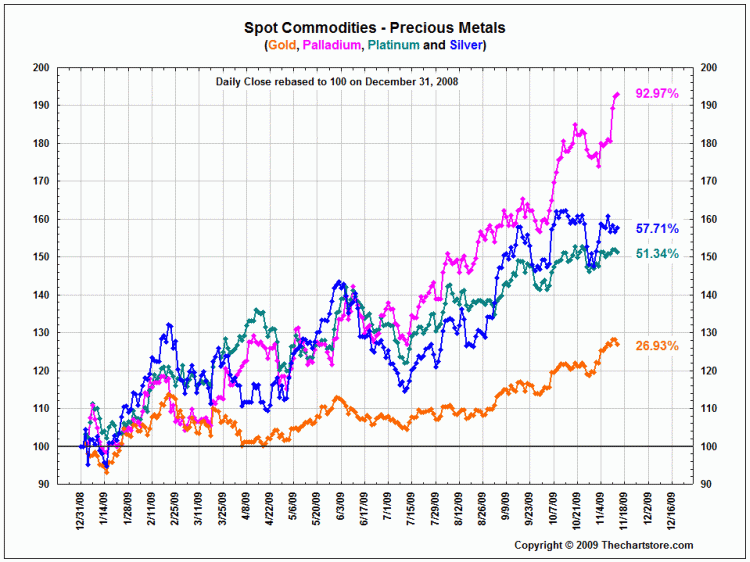
But looking at the performance of palladium price in the past year, how could any one still complain? As fellow SA contributor John Lounsbury also noticed, Palladium already did far better than platinum, silver and gold in the past 12 months. I just wish more people learn the story of the depleting Russian palladium stockpile.

Many years ago, Warren Buffett correctly pointed out that Mr. Market is a fool. My own experience tells me that I could never underestimate the foolishness of Mr. Market, or the stupidness of the world. You only need to look at the global warming hysteric fiasco.

The foolishness of the general investor community can be best reflected in the tellurium story. Two years ago I advocated for hoarding physical tellurium and predicted that the business of First Solar (FSLR) is not going any where, as they could be suffocated by a global tellurium shortage brought about due to the emerging new applications of tellurium based electronic devices, like phase-change memory. How many people listened and believed me? More people in the world understand Einstein's Relativity Theory, then people who understand tellurium supply and demand! Now Numonrx was able to make multi-layer phase-change-memory chips. This is a paradigm shift in the electronics industry. As advanced as the modern microelectronics industry is, they were never able to produce a multi-layer computer chip. It's going to be huge for tellurium and a gigantic jackpot for the tellurium investors.

But for now, people still fight hand over fist to buy FSLR stocks, believing that First Solar can grow its business unlimited. Some investors actually believed that tellurium can be extracted from sewages, because I told them most tellurium is extracted from the slime mud produced during copper electrolysis production. Yeah right! Just don't do it at home and don't dig out the sewage pipe in your toilet. I assure you there is no tellurium to be found.

Full Disclosure: The author hoards physical tellurium, physical palladium, and has large long positions in SWC and PAL, as well as silver mining stocks SSRI, PAAS and CDE. The author no longer holds position in UNG and has no short or long position in FSLR. The author holds other positions unrelated to the discussion in this article.

Wednesday, October 28, 2009

Hot Money, Hot Commodities and the US Dollar Carry Trade Part 2

In the last part of the article I discussed the reason why the collapse of the US dollar is all but inevitable, but the US economy itself will be strong enough to survive. Let me say it again, collapse of the US dollar does not equal to collapse of the US economy. If the dollar becomes worthless, Microsoft (MSFT) or Intel can sell their hardware or software products for gold or coins. They can still manage to make a profit, because the world still want their products.

How do investors protect themselves during a currency collapse?

First, the majority of investors and the majority of average American people will be wiped out financially. That is a FACT of mathematical statistics when a country's currency collapses. Majority of people will be wiped out, but a selective few in the minority will be able to rip huge profit from the crisis. If you want to protect yourself, you can not be with the majority. You must be with the minority group of people. Do NOT let other people do the thinking for you.

So are you listening to the most popular economic analyst or the most popular financial TV host? If you do, you are in danger because you are together with the biggest group of fools! You find safety when you are forced to jump from a big boat to a small boat, not the other way around. Just ask Titanic survivors how they survived. They jumped onto very small boats instead of wait for something bigger than Titanic to come to their resque. Safe havens must necessarily be small and can not accomodate too many people.

Commodities are the only safe haven. As Jim Rogers said, commodities are the only asset class with fundamentals impaired, but improved. But there are lots of myths in the commodity investments. Even Jim Rogers himself had also spreaded some incorrect myths regarding commodities investment. Most people do not know how to invest in commodities because they have not even once laid their fingers on any physical commodity. The only thing they have ever touches is a computer keyboard and mouse. A computer and a brokage account is all you need to invest in commodities, right? Wrong!

The door for commodities investment is extremely narrow. Let me tell you a small story. I am a big fan of tellurium investment and hoard actual physical tellurium. The price low of tellurium a few years ago was about $10 per pound, recent high was about $140 per pound. I predicted tellurium price could go to multiples of gold price once phase change memory goes into wide application. Almost every one laughed at me. Some, a few, did take me up seriously but they ask me NOT where to buy the physical tellurium, but rather, where to buy paper future contracts of tellurium, or what mining stock they can buy. When they hear that these two investment instruments do not exist for palladium, they left with disappointment. Most market traders do not know what to do with physical asset. They would rather prefer the convenience of pushing a computer button to instantly buy and sell something. Till this day, I think there are far fewer tellurium investors than people who understand Einstein's Relativity.

I believe that pure computer trading is the wrong way to invest in commodities. To invest in commodities you HAVE to get your hands dirty and lay your hands on the physical things. Let me explain using the example of the United States Natural Gas (UNG) fund.

Recent dismay performance of UNG gave me pause to think about how to invest in commodities. Natural gas spot price recovered from the low of about $1.84 to now nearly $5, almost a triple, but the share price of UNG still struggles around $10. Why is UNG not tracking the price of the natural gas itself? The simple answer is it's killed by contango. But there is a deeper reason.

UNG does not hold the physical natural gas. Instead they hold futures contracts. In theory, when natural gas price goes up, the asset value of these futures contract also go up. But in reality such methodology is flawed. You are holding future contracts that you never intend to take delivery. So near the expiration of the future contracts, you are forced to sell them, at any low price. Mean while you must buy the next month's future contracts, at whatever high price they are offered. As a result, in each round of the roll-over, UNG loses positions and loses money.

More over, the more investors are interested in UNG, the worse a situation UNG finds itself in. (Remember, the bigger crowd is always the loser!!!) During each roll-over, UNG could be purchasing more future contracts than producers have products available to write those contracts, hence it bids up price on the buying end. Then it turn around to sell the future contracts to industry consumers, it has more to sell than the industry consumers can buy, hence it pushes the price down on the selling end. How could you not lose money? It's like two mechants compete with each other. They bid the price up purchasing produces from the same farm, and then cut each other's throat to sell to customers at super low prices. Both lose.

Since UNG purchases future contracts that it never intend to take delivery, conceiveably on the other end of trade could be some one who write future contracts that he never intended to deliver, as he does not have the product to deliver. As no delivery is ever demanded, such paper future contracts can be created out of thing air in unlimited quantity to "meet" investment demand. Basically one side provides empty promises of supply, the other side provides false demand that never materializes. This is nothing but a zero sum game. One party's loss is exactly the other party's gain.

Therefore it is flawed to believe that trading future contracts is investing in cmmodities. It is NOT. Future contracts are derivatives with which the two sides gamble against each other. The commodity may be bullish, but you have a 50/50 chance to beat your counter party to win.

If you are interested in commodity investment, do NOT buy paper derivatives, whose supply is unlimited. Buy the physical thing, which is limited, and take delivery.

Now from a fundamental point of view, every investor needs to ask: If I invest in something and I gain, WHO pays for my profit? You are not the FED so you can't create money out of thin air. If you make a profit, then some one or something must be paying you that profit. If you buy a stock and make money, it's because the business of the company generates revenue and income, or because another investor pays you more than your original cost. I invested in physical tellurium because I know some years down the line, First Solar (FSLR) or Intel (INTC) will pay me gold price to buy my tellurium hoard.

But who pays for your profit when you invest in a commodity? Do your fellow investors pay you? If so it sounds like a Ponzi scheme. It has to be industry users of the commodity that pays you the profit. The only way for you to get paid by industry users, is for you to participate in the supply and demand of the commodity, for you to become a physical demand and then a physical supply. That means the only sensible way of investing in commodities, is for you to take physical delivery, hold for long term, until the price is higher, then you sell to the industry users.

Once again, The door for commodities investment is extremely narrow. Most of supply and demand have been directly negotiated between industry suppliers and industry users, leaving you no opportunity to participate in the market. Natural gas is a good example. The opportunity to store natural gas is virtually non-existant for outsider investors. Any gain or loss is likely directly settles between industry suppliers and users, and that leaves investors out of the natural gas business and unable to rip profit from the price appreciation.

So if you think investing in commodities is as easy as pushing a computer button, and you do not have to deal with the huzzle of buying/selling, transporting and storing the actual physical stuff. Please pause and think again. WHO PAYS YOUR PROFIT if you are not taking all the huzzles?

For this reason I am inheritly suspicious about all sorts of commodity ETFs, like GLD and SLV. Particularly SLV. Read my previous Instablog regarding some red flags in the SLV fund. What troubles me is that these nice folks help you to take care of all the sweating and laboring to handle the physical stuff, and allow you comfortably making profit sitting in front of a computer. It just sounds too good to be true.

(to be continued...)

Full Disclosure: The author is long precious metal palladium and silver, hold big positions in palladium mines SWC and PAL, as well as SSRI and CDE. I hold shipping stocks like EXM, EGLE, TBSI, DRYS, and small positions in natural gas fund UNG. I short the US dollar by holding some long positions in margin brokage account.

Sunday, July 12, 2009

The Inflation/Deflation Debate and China's Commodity Carry Trade

The inflation vs. deflation debate is heated up again. The debate looks far from being settled, even among professional investors. The average Joes are probably more clueless. This may be the single most important debate in the investment world.

Jim Rogers, Peter Schiff, James Sinclair, Gerald Celente, Marc Faber and Congressman Ron Paul are on the inflation camp. The argument is simple: As the US government racks up trillion dollars of deficit spending, the money can come from neither raising tax, nor borrowing. So the only way out is print money out of thin air. In history, any time a government chooses to solve its fiscal problem through massive money printing, it always leads to hyper-inflation at the end. So that is going to happen. It might be postponed a bit but can not be avoided.

But I will not immediately dismiss the arguments from the deflation camp, either. Well known people on the deflation camp includes Mike Shedlock (MISH), Nouriel Roubini, and market ticker Karl Denninger. They present three strong arguments for deflation:

  1. Credits are destroyed in the ongoing de-leveraging process. Credits are circulated as money so the destruction of credit means less liquidity in the system.

  2. Although the government is massively printing money, most of the newly printed money is just hoarded away in the vaults of banks and do not enter circulation.

  3. Where is the inflation today? It's no where to be found!
Debunking the second argument is simple. Banks keep a high reserve because they are highly leveraged and they fear a bank run. If banks hoard cash instead of extend consumer credits, people will have to withdraw cash so they have the money to spend. Such a bank de-leveraging process could escalade into a bank run, resulting in the destruction of the banks and massive release of cash into the general circulation.

De-leveraging of the financial derivatives bubble does not cause deflation. Look at the history of Dutch Tulip Mania and the subsequent collapse. Did it lead to price inflation and deflation of things unrelated to tulips? Of course it didn't. The Dutch grocery stores never took a flower as a payment for milk and bread. Can I use a credit default swap to pay for milk and bread today? I can't. Inflation is a currency phenomenon. It has nothing to do with leverage.

De-leveraging is the process that people abandon paper assets due to counter party risks, and turn towards physical assets with no such risk. Physical assets have intrinsic values: the marginal costs to replace them and maintain an adequate supply. So in the de-leveraging process, paper assets will lose value, and physical assets will gain value. The US dollar is a paper asset. The dollar is leveraged on the full faith and credit of the US government on its ability to pay off its huge amount of debts, which frankly does not look good at all.

The world knows the US dollar is going down. Chinese students laughed loudly when Tim Geithner told them China's US dollar assets are "very safe". Many very rich and successful Americans know the dollar is going down. People like Jim Rogers are moving their assets out of the US dollars and into China and other places. No wonder the US government is cracking down on Swiss Accounts owned by Americans.

So here is your answer where is the inflation. Blame it on guys like Jim Rogers are selling their US assets! Jim Rogers is a billionaire. He sold his house in New York, therefore New York real estate collapsed. He sold his furniture, sofas and tables and chairs, so that brings the furniture prices down. He sold his US stocks so the US equity market is down. He sold his stuff for US dollars, and bring his dollars away from the US soil, and into China. Jim Rogers drains liquidity from the US market, thus prices of everything drop :-) Speaking seriously: This is an ongoing BANKRUPTCY LIQUIDATION SALE, not a deflation. The low prices will not last.

I told you that is exactly what happened, in my last article. Liquidity is drained from the US market because smart capitals are escaping from US soil to look for opportunities in places like China. This is a huge liquidity drain from the US. But it also causes headache for the Chinese. They need to deal with all the "hot money", the US dollars flooded into China to be exchanged into Chinese Yuan, as speculators are betting on Yuan appreciation over the dollar.

In other words, currency speculators are EXPORTING our inflation to China by draining the liquidity from the US and bringing hot money to China.

How China handles the massive inflow of hot money? China simply print their own money to soak up all the inflowing US dollars. It costs them nothing to print the Yuan to buy the dollars, and they can spend all the dollars to purchase physical assets and raw materials around the world. This is the Commodity Carry Trade they are playing, very successfully.

Few people in the west recognize China's real strategy. They thought it is impossible for China to sell the dollar and exchange it into euro or yen. Why would China sell one paper just to exchange for another paper? They thought China's recent commodities buying spree is to merely boost price to help domestic producers, or to stockpile for strategic safety. But China's buying of aluminum, a material that China has plenty, signals that it goes far beyond strategic hoarding. Commodities ARE China's new foreign exchange reserves. China is not selling the dollars, China is SPENDING the dollars.

With continued inflow of US dollars, and with China's own money printers running at high speed, China has plenty of money to spend and continue the buying spree. With Yuan tightly pegged to the dollar, this game can continue indefinitely until currency speculators stop sending the dollars to China. Then the US will go from being the largest exporter to the largest importer of inflation, over night! All the dollars will fight their way back home at once. Goods and raw materials will flow out of the USA, until this land is ripped barren! I predict many people will be voting with their feet, before the nightmare scenery occurs.

The currency speculators did the wrong thing selling dollars buy the Yuan. The dollar is going down, but so will the Chinese Yuan. Investors should go to physical commodities, not Yuan or any foreign fiat paper money.

Some Chinese already realize that the Yuan is losing purchase power. In recent months, there was a SUDDEN turn up in real estate markets in major cities in China. The housing slump turned into red hot housing boom, literally over-night, caught many people in a big surprise.

Unless you read news in Chinese, you might think I was telling a fairy tale. But it is absolutely true. There is a sudden housing boom; an auto sales boom; a boom in bank loans. Mean while China could NOT sell its own treasury bonds. What does that tell you? China could not borrow a mere Y28 billion Yuan (US$7B) from its own people. Why would China be able or willing to extend another trillion dollars of credit to the US government?

Jim Rogers is absolutely right that commodity is the only asset class whose fundamentals have not been impaired, but improved. One of the best sectors to play the Chinese commodity buying spree is dry bulk shipping, as China's global buying spree is far from over.

Stocks in dry bulk shipping include the follow names:
EXM, EGLE, TBSI, DRYS, GNK, DSX, NM, OCNF and SBLK.

There is a shipping ETF called SEA. Do your own due diligence on specific positions.

Raw materials that China does not produce, but are critically important to China's economy, are the best commodities to buy. This includes platinum group metals, platinum and palladium; aviation metal titanium; battery technology metal cobalt. My best favorite is the palladium metal, and palladium mining plays: Stillwater Mining (SWC) and North American Palladium (PAL). Recently Andrew Snyder published an article pitching palladium as a critical metal for China, and SWC with a potential of 1,389% gain, without naming the names! I am not sure any one knows what China's next big purchase is. But it is a fact that palladium is one of the critical strategic metals that any modern country must stockpile. Look at TIE as a titanium play, and OMG as for cobalt play. I also recommend buying physical cobalt.

If you are interested in rare and strategically important metals, then follow Jack Lifton, a regular writer for Resource Investor. Jack's article on tellurium got me first interested in the metal. I actually bought some tellurium. Read a recent article on First Solar (FSLR) and tellurium: Hard to Find, Easy to Smell. It's amazing that FSLR still holds up well today and there is still no rush to buy tellurium. But as I predicted, Samsung bets big on tellurium based Phase Change Memory. The chip is already in commercial production. I recommend shorting FSLR if it raises near $200 a share. If you hold long or short position in FSLR, you have a fidelity to your money to demand the truth from FSLR on their tellurium supply.

I have high respect for Jim Rogers. But I have a huge disagreement with him on his love of agriculture commodities. I know his agriculture love is very influential and a lot of people agree with him. But I must point out that he is completely wrong on agriculture. In terms of dollar or any fiat currency, all commodities are bullish. But in terms of growth potential in real purchase power term, agriculture products will perform near the bottom, only better than gold.

I don't like gold (GLD) at current price at all. As the world is facing so many resource crisis, I can not understand why the world as a whole still dedicate a lot of efforts digging a metal that is least useful, and least in shortage. Sell gold to buy silver, physical silver, not SLV. After I carefully scrutinized the silver bars list I do NOT believe SLV has the actual silver bars.

On agriculture: granted that the world sees a food crisis looming; granted that every fact Jim Rogers cited is correct: Farmers can't get loans to buy fertilizer; Asian countries eat more meat; And that food is the single most important human need. Despite all these facts, Jim Rogers is still wrong on being overly too optimistic on growth potential of agriculture products.

Jim Rogers doesn't know how the poorest people in the world are struggling to feed their families. There is demand destruction. The poorest people in the world are already spending 80%, 90% or more of their income on food. Farmers could barely make any profit raising their cattle. If food price doubles, do you think the poor people will have more than 100% of their income to spend? Or a farmer can spend more to feed their cattle? No! Poor people will have to buy less and eat less, and farmers will have to slaughter their cattle.

Such demand destruction can quickly reduce food demand, and hence it tightly caps the price growth potential of agriculture products. This is why agriculture products will never be the most bullish of all commodity plays. Agriculture is still bullish, not bearish, but the growth potential is simply unattractive. A number of rare metal plays can easily beat any agriculture hands down.

My last article called to buy United States Natural Gas (UNG) fund. I was a bit premature. But at current price level, UNG has no more down side and plenty of explosive upside potential. A recent EIA report noted an important trend: At current low natural gas price, it could become economically incentive for power plants to switch to burning natural gas instead of coal to generate electricity! Please read that document carefully. If power stations switch from coal to natural gas, the huge demand boost will put a rock solid bottom at current natural gas price. In comparison, I will caution about adding position on US Oil Fund (USO).

Full Disclosure: The Author is heavily invested in palladium mining stocks SWC and PAL. I also hold significant positions on shipping stocks EXM, EGLE, TBSI, DRYS, GNK, as well as positions in UNG. I hoard physical tellurium metal but have no position in FSLR.

Monday, August 25, 2008

The Olympics Games and the Looming World War Three

The 29th Olympics Games has concluded nicely in Beijing, and so ended the One Dream of One Harmonic World. The War of Georgia broke out on the very eve of the Olympics Opening. The fireworks we watched were so brilliantly streaming! And the rockets' red glare, the bombs bursting in air, gave proof through the night that our planet was still not peaceful.

One only needs to look at the map to see the location of the strategically important BTC pipeline, to immediately realize that the Georgia conflict is in no way a regional conflict. It is a global crisis in all aspect. This, people, is the prelude of World War Three! Bush said a nuclear Iran would mean World War Three. Iran also warned that an attack against it would mean World War Three. So then, World War Three must be the inevitable thing to happen.

One little noticed news item caught my attention and convinced me that our government is indeed making strategic preparation for a possible global war. It's recent announcements by the Defense National Stockpile Center. It's public information. On August 7th, DNSC suspended sales of six materials from the stockpile inventory, one of them being platinum. On August 12th, DNSC issued a notice to order beryllium. And then on August 25th, DNSC issued solicitation to purchase pretty large amount of titanium. On the same day, DNSC also solicites purchase of the cobalt metal. Those are official public announcements.

In a previous article, I argued that platinum group metals (PGMs) are better safe haven investments than gold and silver and one reason is that platinum is a critical war material. Big nations attempting to prepare for a global conflict of long duration MUST be hoarding platinum, palladium and rhodium. It is shocking that US government suddenly suspended the sale in the middle of the year. This never happened before in the 20+ years since the end of the Cold War! The hoarding of titanium is even more worrysome, as titanium is an aerospace metal. No wonder that the stock of Titanium Metals Corp. (TIE) suddenly surged up 5.99% on August 25. The cobalt play OM Group (OMG), which I recommended before, also surged up alone as well, as does cobalt price.

I am not a warmonger. I am a peace lover. But facing the reality of global resource depletions including Peak Oil, I think a global resource war is all but inevitable in the very near future. I just hope it doesn't go nuclear. I am happy to see our government is trying to stock up on critical strategic materials like platinum and titanium. At least our leaders are sane enough to want to fight a conventional war, not a nuclear war. Strategic stockpiles are not needed to fight a nuclear war. Push a few buttons and it's all over and there will be no survivors.

Also, while I believe a global conflict is ultimately inevitable and that our government is already quietly preparing for it, as probably are other nations, I do think global war is NOT imminent yet, definitely not in the next few months. The reason is very simple: We are NOT materially prepared to fight a global war, neither are Russia or Iran or any other countries. This hopefully should allow individuals time to shift ones financial assets to safe haven investments, and physically and mentally prepare for the difficult times to come. But a global resource war can NOT be avoided ultimately. So keep that in mind.

Mexico, the third largest oil supplier to the USA, sees its oil production plummet, due in large part to the rapid depletion of Cantarell Field. It is expected that by 2010, Mexico will cease to be a net oil exporter. That's only two years away! Do our leaders not realize what a daunting energy future we are facing? Of course they know.

Investors need to keep an eye on what's happening in the conflicts in the Middle East. As our main stream media is nothing but propaganda and brain wash tools, I recommend daily readings of DEPKAfile, Russia Today, Middle East Times, Rense and Guardian, and always read everything with a grain of salt since every one is inevitably biased.

It's disheartening to see that with global crisis looming, everything valuable is selling off and everything with zero intrinsic value is rallying. Everything is sold off: oil, natural gas, gold, silver, platinum, palladium, rhodium, even cobalt, even my favorite tellurium. Meanwhile US dollar saw it's strongest rally in more than three decades! The world is turned upside down.

I say foolish traders! The first fundamental principle of the market place is that fools are always the vast majority in the marketplace. Most market participants are foolish not because their IQs are low, but because they are too lazy to do their due diligence study, or that they are too coward to follow through in their conviction of market fundamentals. Most people would prefer to just follow the mob, a proven method of losing your money fast and painlessly. The mob mentality makes it that much easier for the big boys to manipulate the whole market any way they want.

Recent commodity sell off, suspiciously synchronized in time, gives one assurance that it has nothing to do with any change in supply/demand fundamentals, but merely reflect a fluctuation in trader sentiments. It's nothing but inherit market volatility when too much money is chasing profit in markets that are just too small relative to the amount of money involved. Rhodium price fell from $10000 per ounce to the low of $3850 per ounce, a fall of 61% in just a month, but then it bounces back to $6200 per ounce, a rally of 61% up in just four trade days! Such volatility is unprecedent in the whole recorded history of any commodity trading. Does any one buying or selling rhodium really know the precise global supply and demand numbers of rhodium? You might want to read an interesting comment of Jack Lifton on rhodium.

James Conrad recently discussed the disconnect between paper and physical metals in the precious metals market. I highly recommend his article and a follow up. I agree there is a disconnect between the paper contract market and the physical metals market. I have a slightly different opinion on whether there is an actual shortage of the physical metals.

I think one needs to look at precious metal lease rates (interest rates) and compare the four precious metals to which one is in real shortage and which one is not. Gold and silver lease rates are so low they are effectively leased almost for free. But platinum one year lease rate is as high as 5.22%, while that of palladium is 3.38%. More strikingly, if you note the date on the lease rate chart, gold, silver and palladium are all recent, but the last update date on palladium lease rate still remains on July 24, 08. Does that mean that not a single ounce of palladium has been leased out for one whole month?! Isn't a high lease rate and a lack of lease activity an indication of physical shortage?

Another interesting development in the platinum and palladium market is that the ETF Securities platinum and palladium fund saw massive drop of physical metal holdings in recent weeks. Some analysts interpret the physical metal holdings drop as an indication of weaning investment interest. But I noticed that the daily trading volumes of the shares are way too low to account for the volume of recent physical metals redemptions. If it was investment funds unloading their holdings, they would just sell the shares in open market and be done with it. Some one directly tendered the shares and demanded redemption of physical metal, instead of selling the shares! I suspect that those are industrial users who purchased the ETF shares in the past, and who now tenders the shares to redeem into physical metals, as a quick way of quietly acquiring the physical metal, without driving up the spot price. If my speculation is right, this is a good indication there is now shortage of the physical platinum metal in the marketplace.

The massive redemption of the ETF Securities PGM metal funds is a great contrast from the massive increase of holdings in the iShares Silver Trust (SLV) and SPDR Gold Shares (GLD).

During times of crisis and uncertainty, people invest in precious metals to preserve fortune because physical metals have intrinsic values and they can be hold and can be easily stored and transported. I do not like gold because gold has little industry usage and is purely driven by investor sentiments. Gold is sold from one gold investor to another gold investor so you are attempting to profit from your fellow gold investor, which doesn't sound right. Metals with important industrial usages are much better value storage. I hoard physical tellurium and I do not need to sell it to another investor, certain industry users, like First Solar (FSLR), will one day pay a hefty price to me when they can't acquire the material else where due to a global shortage. But tellurium is not for every one due to its lack of market liquidity and its mild toxicity. Silver is better than gold as silver is an important industrial metal. Unfortunately the mine production of silver, as a base metal byproduct, is ramping up, while some of its traditional industry application is diminishing. Silver is now in structural surplus and so just like gold, silver price now is driven by investment sentiment, not by the supply and demand.

I recommended cobalt as a better silver and I recommended the OMG stock.

But the best precious metals are platinum and palladium. Platinum is a way much better gold, while palladium is better than platinum due to current price disparity. Unfortunately, physical palladium coins and bars are now extremely hard to find. If you like the PGM metals, consider buying the stocks of Stillwater Mining (SWC) and North American Palladium (PAL). They are the ONLY primary PGM metals mining companies outside South Africa and Russia. Russia, being the dorminant palladium producer, can cut back export and boost the palladium price at any time, in their own interests. South Africa continues to struggle with a national electricity crisis which greatly impacts the output of its PGM mining industry. How do you figure ESKOM, South Africa's national electricity company, is paying about US$10 per ton for coal while the rest of the world is paying $150 to $200 per ton for coal? They are forced to use discard coal! How long can they continue to burn trash until a catastrophic system break down happens? The CFO of ESKOM has just resigned, another bad sign things are not going well in that country.

I would also recommend buying U.S. OIL FUND ETF (USO) and US NAT GAS FD ETF (UNG). This market is rigged to the extreme. Hurricane Gustav blow through and forced the shut down of oil platforms, and oil and gas dropped 7% overnight? Maybe we should have more category 3 hurricanes so that we can all enjoy cheaper oil and gas. The marketplace has become a giant casino. The only way to fight this casino and win is stick with the fundamentals and stick with logic and common sense and do not run with the mobs.

P.S. The Author hold large long positions in SWC and PAL.

Tuesday, July 15, 2008

The Best Safe Haven Investments

Make no mistake about it, we are in the midst of an unprecedent crisis. Every one is watching Fanni Mae (FNM) and Freddie Mac (FRE). Every one knows what a collapse of these two mortgage giants could mean, and what a high cost a government bail out would be. I encourage you to watch what Jim Rogers had to say about the crisis. I also encourage you to read Jim Sinclair's daily commentary to understand what's going on.

People, wake up! This is a worse crisis than even the Great Depression. I don't see any one in our government capable of handling it. The best you can do is try to protect yourself. You must put away a certain portion of your financial asset into something that is directly under your own control and protection. I mean physical assets that you hold to your hands!

Don't put your money in a bank. As what happened at IndyMac Bank (IMB) shows, banks are extremely vulnerable to bank runs. If you wait until a bank run occurs to withdraw your money, it is too late. FDIC does insure bank savings up to $100K. But FDIC does not have an unlimited amount of funds to insure every one against loss, nor do they insure against lost purchase power of your $100K. I do NOT intend to cause bank runs. I do NOT want to see a total collapse of our financial systems. But I think that if enough people have their money in their hands, instead of in the banks, then people will have much greater confidence in their financial security, and there will be much less panic. I don't want to see people panic. The way to prevent panic is to remove reasons for panic. If bank runs are inevitable, I would rather see a slow and gradual bank run, where people withdraw maybe a couple hundred dollar a day. It's a way much better than ten thousand people all rush to the same bank at once and grill under the sun for 6 hours in the queue.

So here is my second point, after you get your money out of a bank, do NOT put it under your pillow. Cash stashed away under a pillow is useless and doesn't protect you, because our dollar is losing purchase power at a rapid pace. So instead you should spend your cash to buy things. Your purchases will put the money right back into the circulation of the monetary system and hopefully provides some stimulation to the economy. Hopefully by spending your cash away, the vendor who receives your cash payment will deposit it into the same bank, who will then stash it into the same ATM machine, so you or some one else can withdraw another couple hundred dollars the next day. That improves the liquidity of the system, doesn't it?

So what do you buy with your money? You need to buy useful things that can preserve value both in good times and in bad times. Buy dry food items that can be preserved for long time. Buy toilet paper, a lot of them! You need toilet paper WSHTF. I am half joke and half serious with toilet paper here. You need to buy toilet paper as well as any daily use items, paper towels, detergents, whathaveyou, non-perishables that can last 5 years, 10 years or longer, because price of everything is going up fast. Why do you invest in something else that appreciate slower in dollar terms, and you have to pay capital gain tax, and then at the end of day you could only buy less of the things at much higher prices? You might as well just buy a whole closetful of those useful and non-perishable daily items, which probably appreciate in dollar terms faster than any other investments. And you don't need to pay any tax on the appreciation either. Hopefully through your big grocery purchases, you help to inject a little bit vitality into our economy by helping the workers who make the toilet paper or the detergents to keep their jobs.

You also need to buy things that takes up less space, is less useful to you, but preserve and increase value over time. Of course everyone will immediately think about precious metals and when it comes to precious metals, you immediately think about gold. Most people probably think gold is the best safe haven investment. But I actually believe gold is the worst of all inflation hedgies. In the past 8 years the performance of gold lacks behind many physical commodities. That's a fact. People who bought gold near the 1980 high still haven't recoped their losses. The most famous gold bug sold all his gold exactly one day after gold peaked in 1980. Don't bet on selling exactly at the peak unless you have that kind of timing capability. Most people really should bet on being a sucker who always get the timing wrong.

I am NOT a gold bear. I honestly believe that gold will reach the $1650 per ounce target Mr. Jim Sinclair predicted, and probably get there faster than his prediction. But that alone is not a good enough reason to invest in gold. Because you probably are losing instead of gaining in purchase power. A one ounce gold coin probably buys more rolls of toilet paper today, than it does in the future when it reaches $1650. What makes gold special than other metals just because it is labeled as monetary metal? Copper is monetary metal, too! So is silver! So is nickel! Do you know that the first batch of immigrants spent a whole summer searching for gold and the local Indians, who consider gold as decoration rather than money, figured that the white men must eat gold as food. Most of the first group of immigrants died when the winter came and their gold could not buy them food. An interesting historical lesson.

Natually, from a long term point of view, a commodity's value is often determined by the cost of producing it. If it is very profitable to produce, it encourages more mining and production, bringing supply up and price down, and if it is un-profitable to produce, the mines will shut down, reducing supply and bring price up again. There are only two exceptions. One exception is if the production of the commodity is inheritantly limited by the availability of natural resources. Production can not be boosted even at high prices, for example oil, or platinum group metals. Another exception is when there is already a huge stockpile above ground, enough to provide many years of supply, then annual production no longer matters. Examples of second exception include both gold and silver.

Gold is the most abundant of all commodities, in all of humanity's history. Abundant in terms relative to annual physical consumption. Gold has very little industry usage. Most of gold is used to make jewelries or gold coins. Old jewelries and coins are routinely recycled and refined into pure gold, feed back into the supply chain. If all of the world's gold mines are shut down for a few hundred years, I don't see a problem at all. The existing global gold stockpile can supply the world's need for a few hundred years before a shortage develops. Gold price may raise a bit but then wearing gold jewelry may go out of fashion which brings down demand.

The world has enough gold stockpile to last a few hundred years! Try to imagine a world that has enough copper stockpile to last a few hundred year, or a world that has enough corn stockpile to feed the population a few hundred years! What would that do to the commodity price? The bottom could fall off! But gold is an exception. The whole world's gold mines can all shut down for a few years, it will not boost gold price much. Likewise, if number of producing gold mines double, it will not dent the gold price much either. Gold's price level is largely affected by investment sentiments, not supply and demand. But investment sentiments can go either way. People never hesitate to sell their gold whenever they find something that's more attractive as investment than gold. Only when they can't find anything better to buy, will they return to the perceived safety of gold to try to preserve fortune. But do we really have nothing better to buy than gold today?

Of course there are better precious metals to buy. Namely the platinum group metals, platinum and palladium. They are way much better than gold. South African mines shut down for 5 days in January and it sent platinum price and palladium price spiraling up for a month before the correction. You can clearly identify when the shut down happened by looking at the price charts. The same event also shut down all the gold mines in South Africa but you won't be able to tell it from the gold price chart. What does it tell you? The PGM metal supply is so tight that a 5 days disruption is enough to cause panic. The same can not be said about gold.

Regardless of how you think about the PGM metals supply/demand fundamentals, there is a very solid bottom of PGM metal prices for which you have assured protection and assured hedge against inflation. The bottom is the price level at which the current PGM mining companies can ensure at least a moderate profit margin, even with increasing cost of energy and mining equipments. You can not say that for gold or silver mines.

The reason is very simple: if the PGM price falls below the profitable level, one or more of the major PGM metal producers will be forced to reduce production or even shut down, as you can not operate a non-profitable business for long. When that happen it will tilt the dedicated supply/demand into shortage and send the metal prices spiraling up, until the mines can profitably re-open again. I talked before about the price inelastic nature of PGM metals supply. But I think I must make a correction: It's a one way street, higher price is unlikely to boost production. But lower price would be rather quick in cutting down supply when PGM producers become un-profitable.

A few years ago, when palladium price was at the bottom, Stillwater Mining Company (SWC), one of my two favorite palladium mining company, was able to sign palladium price hedging contracts with major auto makers, and was promised palladium floor price much higher than the going market price at that time. Because the industry users could not afford to let SWC go out of business, and therefore depriving them an important supplier of the palladium metal! It was a shame that we allowed the Russians to grab a majority stake in this strategically important national treasure of ours, sold out at dirt cheap price.

Judging from recently quarterly reports of Stillwater Mining Company (SWC) and North American Palladium (PAL), both of which only recently turned modestly profitable in Q1, 2008, the current platinum and palladium prices are probably not very high from the solid profitability bottom. The industry can not afford to drive any of the world's PGM producers out of business because they can not afford to lose any portion of the tight global supply of the PGM metals. This ensures that the price of platinum and palladium WILL continue to grow, commensurate with the raise of energy, raw material and salary cost. You can't have a better inflation hedge than that!

I was once heavily invested in SLV, the iShares Silver Trust, although I could never get really interested in GLD, the SPDR Gold Shares. That was before I spend extensive amount of time really try to understand the market of palladium and platinum. On the internet there had been lots of speculation whether SLV was backed by by real physical silver, until eventually Barclays (BCS) released a long list of silver bar serial numbers, ending the speculation. I think in a stable market cndition, it would be OK to invest in either the GLD and SLV ETF funds. But at a time when you can't even feel safe leaving your money in a bank, why would you feel safe leaving your share of gold and silver to be watched by Barclays? You'd better take delivery of real physical gold and silver metals in your own hands. Not to meantion that palladium and platinum is way much better.

It is ridiculous that the share price of SWC and PAL have been supressed to such a rock bottom price. I do not know why. You have hundreds of gold mining companies to buy, hundreds of silver mining companies to buy. When it comes to PGMs, there are really not many choices. When it comes to primary palladium producers, there are only these two hidden gems. If I had enough money and was able to acquire a majority stake of both company, here is what I would do to realize the true value of these two gems. I think I will temporary shut the businesses down for 6 months, pay the workers regular salaries and extra bonuses to vacation around the world. Let the industry and investment community panic about the supply disruption and let the metal prices run up. Then people will realize the value of PGM metals, and then they will recognize the true value of SWC and PAL. I think that's how free economy works. You don't operate any business unless it is quite profitable, or will be quite profitable soon.

Finally I want to comment on a recent news piece by Nikkei. Clearly this news release by Nikkei has spreaded around the whole internet in just two days and it caused quite a bit of turbulance in the platinum price. The news said that Nisshinbo Industries Inc., a Japanese chemical product company, has developed a new fuel cell technology that is platinum-free. If that is truth, of course that will remove a big chunk of the expected future demand of PGM metals from the fuel cell sector. But how credible is that news story?

I frankly believe it is either a careless rumor, or a deliberate rumor, for several reasons. One is so far Nikkei seems to be the only source of this story. If this story was truth, this would be a very important technology breakthrough, a Nobel Prize worth of disruptive new technology. Hundreds of research institutes spend decades trying to find a non-PGM based fuel cell solution and the search has been fruitless, and this company no one heard about suddenly announce they did what no one has accomplished?

The Nisshinbo Industries Inc. company itself would have to issue a formal press release and call in a press conference to announce such a break through. There is no such mentioning on the company's web site. Even if the company did not choose to release a press release itself, but rather through third party media, logically it would choose to release the news through a technology, industry or academic publication. Why would it choose to leak the news to Nikkei, a financial news media. It would be totally unethical to skip normal publication channels for technology matters, and choose instead to utilize a financial news media to announce a technology breakthrough, because MBA folks in the financial sector would NOT have the expertise to be able to scrutinize matters related to the intimate details of technology.

Nisshinbo is a chemical comany involved in a broad spectrum of products. They do not specialize in fuel cell developments. They do not make whole fuel cells. They do make components for fuel cell batteries, a component called fuel cell separator plates, or bipolar plates. They do indeed have a carbon nano-technology in making those bipolar plates. But those bipolar plates are NOT where the PGM metal catalyst sits. Nor does Nisshinbo make the catalyst for fuel cell. I never heard anyone using carbon as a catalyst! I searched the whole Nisshinbo web site, and found dozens of mentioning of fuel cell, but not a single occurance of the word "platinum". I searched for any possible patent they could have filed, and could only find one patent related to the carbon based bipolar plates. So I really don't know there this "carbon based platinum-free fuel cell" thing come from. I am in the process of contacting Nisshinbo and seek a clarification. If any one reading this has contact with Nisshinbo, please forward my article to them and seek their comment and clarification.

Rumors spread fast. But truth spread slow. On a side note, I wrote in the past about tellurium and how First Solar (FSLR) critically depends on this rare element. My articles falled into deaf ears so far. One news piece yesterday really caught my attention because I think it is extremely interesting that a seemingly empty shell company would attempt to purchase a critical source of FSLR's tellurium! I don't want to spread rumors. I have my own speculation but I will not say it out here. Let people read the news themselves and speculate on their own. Suffice to say that I think I really need to short FSLR before its coming earnings release. I still have not heard any thing from FSLR. I hope they can give me a good reason not to short them.

P.S. The author is heavily invested in SWC and PAL, and hoard precious and rare metals. I currently do not have any short position in FSLR but is considering shorting it soon.

Tuesday, June 10, 2008

Investing In a Resource Constrained World Part Five

In a previous article I touched the topic of Peak Oil and even meantioned the Malthus Theory. The validity of both theories can not be disputed because both are extremely simply and perfectly logical derivatives of mathematics. In the case of Peak Oil, it's been validated by the peaking of individual giant oil fields, and we are just now experiencing the peaking of global oil supply. In the case of Malthus Theory, it has been validated by hundreds of historic events thoughout the human history.

The purpose of my articles is to talk about investments. But it is necessary to divert away a little bit to talk about the paradigm shift of our society first, before I come back to talk about investment ideas.

We are experiencing some gigantic paradigm shift as crisis unfold right in front of our eyes, due to natural resource depletion. It is important for individual investors to understand what are those crisis and how do we cope it, in order to survive and prosper in the looming crisis.

Unlike most Peak Oil advocators who are extremely pessimistic, I am an optimist. I have been pessimistic the first time I learned the Peak Oil concept. But the knowledge about the Malthus Theory actually turned me into an optimist. Humanity have faced many many crises before, each could have wiped out humanity from the surface of the earth, but we survived for millions of years nevertheless. So the looming resource crisis is no different and probably no worse from any of the previous crises humanity has faced.

Let me explain Malthusian in simple terms. A fish in the ocean, for example, can lay a few million eggs at a time. Each egg, given the proper opportunity, can grow into an adult fish and it can lay a few million eggs of its own. If you multiply a million by a million and keep multiplying, pretty soon you reach an astronomical number that total number of fish can easily fill the whole ocean, or fill up the whole galaxy. Of course that could never happen. Most eggs got eaten by other fish as food, before or after it is hatched. A pessimist would think that what if all one million eggs are eaten and not even one survives to grow up? Then the fish could go extinct pretty fast. That does not happen either. It just so happens that out of 1,000,000 eggs, 999,999 will not survive but in average exactly one will survive to lay eggs, no more and no less. The nature has a way of regulating fish population based on available natural resources like food and habitat. The Malthus Catastrophe happens on a daily basis for fish. But I do not see any fish being pessimistic. They have been living happily for millions of years and just keep laying as many eggs as they can. Life goes on. Shouldn't human society, with our collective intelligence, cope with our own Malthus Catastrophe better than fish?

The unfolding energy and natural resource crises, in my opinion, is a population crisis. The global population simply exceed what the earth's natural resources can support. If we have one billion people instead of six billion, then we still have plenty of oil and other natural resources left for every one to consume. There are ways to cope with it, peaceful ways, through conscious population control (like the family planning policy in China), and conscious reduction of consumption. We must abandon our American lifestyle of materialism. China, with a population five times that of the USA, and consumes only one third of the oil, and it manages a much robust economy than the American one. So America should be able to survive with much less oil consumption.

Skyrocketing oil price has already forced many American families to try to adopt and cope with over $4 a gallon gasoline prices. Abandoning driving altogether is impossible for most Americans. But abandoning SUVs and big pickup trucks in favor of smaller, more fuel efficient cars, is what people have been doing. The trend is very clear, sales of SUVs have stalled, but sales of cars are booming. The total auto sale in recent month have dropped some what, only because auto makers have not been able to respond to the demand change fast enough. My opinion is auto sales actually will see a few years of hyper boom, because people will retire SUVs and other inefficient vehicles, well before the useful lifespan of these vehicles. There will be a huge demand on new fuel efficient cars, to replace these SUVs on early retirement.

My advise to people is SELL your SUVs now, while you can still fetch a decent price for it and use the proceedings to buy a new fuel efficient car. You wait longer and more of these oil guzzlers will show up to flood the used car market, and dent the resale value. You should also buy a Prius, the most fuel efficient car you can buy today. I do not own stocks of Toyota Motors (TM) and I do not think they make a terrible amount of money on Prius. But I am getting 66.6 miles per gallon so I can afford a much higher gasoline price than most people do. Toyota could not produce a lot of Prius due to battery shortage. It costs a lot of nickel metal to produce the hybrid batteries. So buy a Prius while you can still lay your hands on one.

I can see there will be continued global nickel shortage due to auto makers rapidly ramp up hybrid vehicle production, but also due to ramped up effort to develop deep sea oil resources. You need gigantic oil platforms, called oil rigs, made of millions of tons of stainless steel, which needs nickel. There is a global shortage of oil rigs, so expect stainless steel and nickel demands ramp up just on this account. Check out the phenomenal raise of RIG and you know there is a severe rig shortage. Buy any producer of nickel while they are now cheap thanks to the recent nickel price correction, which now seems to have bottomed. That of course includes my favorite palladium stock, PAL, because nickel is the most important byproduct of PAL. I am also thinking about TGB, which I once owned in 2006. I still like it's low P/E ratio. Was its recent fall due to nickel? If then, it's good reason to buy on the dip, since I see nickel has bottomed in the current round of correction, especially in light of the big blow up in west Australia.

The solar sector has been hot in recent months but have cooled down some what. Do I consider any solar stocks a good buy here? I have longed and shorted TSL and LDK in the past but I considered them merely trade stocks and I no longer own them. My opinion is Solar PV is NOT the solution of our energy crisis, not silicon based ones, and definitely not the CdTe solar panels that First Solar (FSLR) produces. I suggest that you read an article called Order of Magnitude Morality. The point to make is production of solar PV products are extremely energy intensive. Although it looks like the energy consumed in producing these solar panels will eventually be paid back, due to their long lifespan, it does take up to ten (10) years to payback the energy consumed, fifteen (15) years if you count in everything, including transportation, sales, installation and maintenance. Massive ramp up of solar PV production will consum a great portion of our existing limited energy supply, make the energy shortage that much worse, before the energy contributed by these solar panels can start to make a difference.

Because of energy payback time as long as 15 years with everything counted, we could NEVER ramp up Solar PV fast enough to replace our energy supply. We don't have the time. For example, if we immediately dedicate 5% of today's global energy supply to solar PV manufacturing, which is a stretch because the world can hardly afford even 1% of spare energy supply now. But let's say 5% is available. By the end of the year, we will have produced enough solar panel to provide 5%/15 = 0.33% of the world's energy needs, reduce our reliance on fossil fuel to 99.67%. The next year we can dedicate 5%+0.33% = 5.33% of the energy to solar PV industry. And by the year end we have another 0.355% available. It would take 11 years for solar PV energy supply to reach 5% of the world's needs, and another 11 years to reach 15% of world's energy supply, and another 11 years to reach 35%. 33 years and we are still only at 35% of the world's energy needs.

I do not like any of the solar players in the market today. They all rely on government subsidies in order to prosper. I am a believer of free market and I am against all government intervention in the marketplace. Let the free market speak if it is something beneficial for the society. I am disturbed by the fact that why my tax dollars should help to pay for 60% of the cost of solar installation for my neighbor 100 houses down the street? He may think he got a good deal from the tax break. But he will continue to pay tax to help the No. 99 neighbor to install solar panels, and then No. 98, 97 etc. At the end of day whatever tax break he initially enjoyed, he pays back in future taxes. The tax money doesn't come from no where but from our own pockets.

One exception is ENER, which I meantioned before favorably, and still consider it a favorite long term play due to it's hybrid battery technology and other unique technologies. I consider inventor Standford Ovishinsky the Thomas Eddison of our time. The stock is very volatile so I would recommend buy it on the dips, not on the rallies.

The solar sector is hyped up by the Wall Street. If you have learned a lesson from the 2000 IT bubble, the lesson is don't follow the hypes! That reminds me of another sector wall street hyped up two years ago, the ethanol sector. The most notable stock in this sector is PEIX. I noticed it in early 2006 and I told folks don't buy it at $40. You will lose your money. Turning the food, corn, into the fuel ethanol, is never a very profitable idea. It is never a solution to the energy crisis. Don't listen to the hype, even if Bush himself hyped ethanol. Today, unfortunately PEIX trades at merely $3 a share. Ethanol price has gone up, but corn price has gone up even more, making PEIX barely profitable. All of a sudden every one now denounces the ethanol industry of consuming all the corn in the world, causing global food crisis and famine and all that.

I am a big believer of contrarian thinking. I did not buy JRCC and just watched it rally to $16 in early 2007 when there were all the drum beatings. But I rushed in and bought tons of it at $4 when no one wanted to touch it. Today JRCC is well above $46 and there are lots of drum beatings again. My advice to people is sell JRCC now. I am not saying it is the top. Don't try to catch the top, which no one can. There are much better opportunities else where than to squeeze the last few dollars out of JRCC.

I am tempting to apply some contrarian thinking in PEIX at below $3 now that no one touches it. I do not view it as the savor of the world. My investment goal is not to save the world. The ethanol industry is not the solution to the world's energy crisis. But it has its reason to exist as a legitimate business, satisfying some legitimate needs. When we truly run into oil shortage, and we can turn corn into ethanol to supplement the gasoline supply, I don't see why not! Burning food as fuel for transportation needs is nothing new. The First Emperor of China practiced exactly that 2222 years ago, i.e., burning food as bio fuel for transportation needs in order to bring supplies to his powerful army thousands of miles away. The transportation vehicles he used were driven by machines called horses, they consume food as biofuel in order to obtain the energy to drive the carts. 90% of the food transported is consumed by the humen and horses on the trip, and only 10% reached the destination to supply the army. If the trucks have no diesel fuel, no food can be delivered to your local stores. I would rather prefer to allow part of my food converted to bio fuel to allow the trucks to bring the rest of food to my grocery store. So maybe we should give it some thought if this is the right time to buy some PEIX or other ethanol players. Could PEIX develop alternative feedstock than corn?

I have a big dream that the success of Cold Fusion, now called low temperature nuclear reactions, may become a reality and we will have solved humanity's energy crisis for good, and saved civilization from catastrophic collapse. I know that from the fundamental point of view of quantum mechanics, which says that particles always have certain possibility to tunnel through energy barriers, cold fusion is NOT impossible. Think of all the hundreds of scientists who have resisted tremendous amount of peer pressures and continued the experimental research of cold fusion for 19 years of best of their times. Do you think they are all clueless crackpotists, or they are really up to something? Recent successful public demo by Yoshiaki Arata, a highly respected physicist in Japan, should bring people renewed hope that cold fusion could become a reality and could be the perfect solution for our energy crisis. Of course if that is the case, palladium price has got to go up a lot higher. Palladium is used to trigger cold fusion reactions. I recommend people to watch the video series War Against Cold Fusion to understand it. Instead of advocating for drilling the ANWR and depleting America's last bit of remaining oil as fast as possible, shouldn't America at least spend a few million dollars to check out the reality of cold fusion, when other countries like Russia, China, Japan, India and Isreal already beat us in the cold fusion research? Shame on the short-sighted politicians who only know ANWR!

Metals are my favorites. Base metals and precious metals. My all time favorite metal is tellurium, which I discovered when I studied the prospectus of FSLR. I talked about tellurium here and here. On a side note, I can not believe how stupid the street is, I talked about FSLR's RoHS risk back on Nov. 27, 2007. It's been so long since my article was published and no one paid any attention. And now they suddenly discovered the toxicity of cadmium, and speculate that CdTe solar panels could be banned in Europe. I think it is irresponsible market manipulation. Any competent analyst should have read FSLR's prospectus from day one and know about cadmium and RoHS. On this I want to come to FSLR's defence. They have documented the RoHS risk in the prospectus and in annual filings so they have not hidden anything. Recent news fuss made it sounds like FSLR just made an announcement and that a EU ban on CdTe solar panel is suddenly imminent. I think it remains just as speculative today as last year whether Europe will take actions to ban CdTe solar panel or not. I so far have heard nothing that indicates a move to ban is imminent, so it remains just a speculation of a possible event so far. Was it an attempt of the street to lure in some unsuspective fresh shorts, and then run another round of short squeeze? I remain skeptical because I know how this market could be rigged in either directions, with analysts often selectively distribute information they see fit.

The real risk of FSLR remains how it is going to resolve it's tellurium supply. I talked about it quite a lot and I tried to dig out information. But the FSLR management do insist that they have adequate tellurium supply. Since they have never revealed the actual data on their tellurium supply, we the outsiders can only speculate and discuss opinions, and the fact remains something only FSLR knows, until such time they are willing to come to the public and discuss it. Maybe they need more time for insiders to sell? One thing that I think I am sure is one day my stash of tellurium hoard might be worth its value in gold. I wish there is a tellurium mining stock to buy.

But really palladium and platinum are the next best thing. They are way much better than gold and silver. I could never bring myself to like gold. I did once buy gold stocks like NG and NXG. Now NG is less than half where I last sold it at $16+. I now frankly think gold is the worst of commodity investment, and gold mining could be worse. Of course as fiat currency depreciate, gold's nominal value in fiat money looks higher. But you still have nothing to gain. Go to Zimbabwe. You can exchange a gold coin for one trillion Zimbabwe Dollars. You feel good being a trillionaire but you are not getting rich.

Gold is money since ancient time and is still money today. I have a problem with that fact! Money, as an exchange media, must be something that people are willing to take in and equally willing to let go. If people want to hoard it but do not want to let it go, or people are rather happy to give it out and hate to take it in, then it can not be exchanged freely as a trade media. So by the virtue of gold being the money, it is something perceived to have near constant value in real term, people have a neutral sentiment in owning it or dishoarding it. and that is exactly the reality. There are more than 160,000 tons of gold being hoarded by different people and organizations. Any trade of gold, is largely between some hoarders of gold and some other hoarders of gold. The mine supply and jewelry industry demand, in this case, is relatively small in comparison, and does not have a material impact on gold's price. There could never any shortage nor any surplus of gold. I would rather buy silver than gold on the Friedman Theory. On silver have a look at SIL and CDE. Could be good bottom fishing target. While PAAS is now more expensive than silver itself. If you want leveraged gain on silver then buy some SLV. Similarly use USO and UNG to play on the oil and natural gas commodity prices.

I would like to look at things from the point of view of basic supply and demand relationship. If I want to invest in a commodity, I need to know that it's price must go up. I need to know that it is in demand and that there is a supply shortage. I also need to know how elastic or inelastic that the price change may affect the supply and demand, and bring back the balance. Something that is price elastic, that higher price could easily boost supply or cause people to reduce usage or seek alternatives, will have less room for price gain. On the other hand, if it is something price inelastic, that higher price will neither boost supply, nor persuade industry users to stop using it, or there is simply no alternative or replacement, then it is a commodity that has a lot more room for price to appreciate.

Palladium and platinum fits such description of commodity that is in short supply, that is in ever increasing demand that is rigid and non-negotiable. The supply is in shortage because the ongoing electricity crisis in South Africa, which greatly impacts production in this main PGM metal supplier of the world. The electricity crisis sees no solution until at least 2012, according to ESKOM and other reports from South Africa. The PGM production disruption is well documented for any one willing to dig out first hand information, instead of relying on second hand guesses. On page 9, table 3, you see the March, 2008 PGM production is down 28% from last March. SA supplies 85% of the world's platinum and 35% of palladium so that's a lot of global supply reduction.

Curiously, the trade of platinum and palladium so far has not followed the way the fundamentals of supply shortage dictates. Instead they follow gold and silver. Gold up and PGM up. Gold down and PGM down. What does PGM's own industry supply/demand has anything to do with gold or inflation hedge? I guess the metal traders are just slow in digging out useful information. If it takes the street almost two years to dig out something well documented in FSLR's IPO prospectus, it doesn't surprise me at all that the reality of South Africa's electricity crisis hasn't even sink in yet even in the minds of some of the most well known metals analysts, let alone the average investors. But soon the PGM fundamentals have to kick in. Industry users must buy for their consumption. The price movement will wake up investors.

I know one hedge fund manager, a physics graduate and very successful in his career, manages billion dollars of assets and claims to be a good friend of a briliant trader, Brian Hunter, whose one single mistake killed Amaranth Hedge Fund. I tried to talk to him about palladium and he told me right away he knew palladium, and there were lots of palladium mines in Canada, and he knew many funds who bought the physical metal. He totally believed he knew it but he really didn't. If a bright guy with such a good background could be so clueless, the average wall street investors must be in total darkness, and of course the computers they use to trade is even more clueless about fundamentals of the markets.

So be patient, spend your time do your own DD. Dig out first hand information and do your own analysis. If you have done so you have beaten the street already. If you further have the determination of sticking to fundamentals and not be swayed by the mindless computer trading of the big funds, then you will win big time at the end of the day. I am sticking to my investment in PAL and SWC since I have done my homework, and checked them many times and could not find any thing wrong with my analysis. And I will patiently wait for the market to wake up to the reality I have discovered long ago. Meanwhile I am taking pride in my legacy of the first individual tellurium investor in the whole world. I made the correct call at the lows of JRCC and ENER, so I know I have the sharp vision. I am not envy about the recent astonishing rally of JRCC and ENER, because I know in time, PAL and SWC will do much better.

P.S. The author is heavily invested in the stocks of PAL and SWC. I have hoarded physical to speculate on tellurium price appreciation.