Tuesday, January 15, 2013

Blatant Censorship By Seeking Alpha on Shale Gas

They have finally imposed communist style information cersorship on the fact that the US shale gas industry is a bubble to be burst! People be aware, when vested interest group feel the need to use such extreme censorship to supress useful information that investors want to know!


Seeking Alpha author Mark Anthony has been critizing the US shale gas industry. He used compelling data and statistics to show that production of shale wells decline fast and fall far short of projection, and that the shale industry is deeply un-profitable, and it will lead to the collapse of the US natural gas industry. Read these pieces before they disappear altogether:


http://seekingalpha.com/author/Mark-Anthony/articles


As a result of dirty hands of vested interest group from the industry, Seeking Alpha now completely banned Mark Anthony from writting any article or instablog posts, making any comment on any article, or even responsing to any private messages sent to him for private discussions. He can still receive private messages sent to him. But he cannot respond any more.


Mark Anthony is considering formally file a complain to SEC on blatant information supressions and market manipulation by Seeking Alpha. He has done tremendous research to dig out the truth of the shale industry. Agree with him or not, the public deserves to learn what Mark Anthony has discovered in his research. Especially when it involves a trillion dollar industry, the public need to know the truth. The public deserves to know the truth and hear different opinions.


The shale gas industry is a bubble to burst soon, due to high debts and deeply money losing shale adventure. As a result, natural gas supply will be disrupted, leading to much higher gas prices, benefitting the US coal sector. But I have repeatedly warned people that UNG, a paper future contract based ETF, is NOT the right vehicle to reap profits from the looming gas price rally. Stay clear of UNG and move to coal names JRCC, ANR, ACI, BTU, WLT etc.

Saturday, January 12, 2013

How Many Marcellus Shale Wells Exist in PA

The PSU Marcellus Research Center has a map showing all the shale gas well permits issued since 2007. See below:


The total comes to 11857 wells permitted as of the end of 2012.

Yet there are only 2000+ wells with reported production in PA DEP's twice per year production reports. WHY?

The US Natural Gas Industry is a Colloseum

The Colloseum is an ancient Rome amphitheatre where gladiators fight against each other until only a few strongest ones stand till the last.

In a sense, the US natural gas (UNG) sector is now a colloseum. There are too many players in this sector. They just have to kill each other, until there are only a few left at the end. I guess that happens to all economic sectors where there are too many players. Competition always do the job of eliminating too many players.

In the beginning of 2012, as decade low natural gas prices hurt producers, we heard a lot of producers vowed to curtail production to bring supply/demand to balance. By the end of 2012, we found that few NG producers actually did what they promised and curtailed their production, or postponed bringing new wells to production. Only one who actually curtained any production is Chesapeake Energy (CHK) who claimed that they ended the curtailment of about 0.2 BCF/day production as of end of Q2 of 2012. Why were producers eager to claim they were going to curtail production but were reluctant to do it?

If you go to investor presentation made by each individual producers, you heard the same story repeated: They all boast to investors how fast their productions have been growing, and how they project they will continue to grow.

Do you see the irony here? If every one keeps growing, the market will be more over-supplied, and the prices will continue to be killed, and it ultimately leads to the demise of their own industry. They understand it. They understand that the whole industry as a whole, they must keep production checked. They can not continue to grow recklessly. But as individual company, they want to see their own to continue to grow and expand. Because that is how they win the competition and get ahead of their competitors in attracting investment capitals.

It is a do or die situation. The shale oil and gas industry is a very capital intensive industry. They must spend large sum of capital money to drill and develop wells. So far the revenue stream is only a fraction of the capital spending. They can not sustain well drilling from cash flow from the business, they need continued injection of money from capital investment and from debt borrowing, in order to continue to drill wells. But the more wells they drill, the more they drive down the price and the more money they lose, which means they have to borrow more and beg the market for more capital investment money.

But then, it means they must continue to pitch an ever rosier pictures and try to portrait their business as rapidly growing, in order to make a case to continue to attract investment money and bank loan. Imagine the alternative. If the producers tell the truth that current NG prices are deeply non-profitable, and that they can not sustain their business from cash flow from revenue, and that they have no money to drill more wells, and that their production will fall and thus revenue stream will decline, and all that, and then they tell the banks and investors: please give up some more money so we can continue to drill more.

Imagine they say that to the banks and investors. Do they expect to get a dime of new loans or new investment capitals afterwards? No! They can not do that. Admitting facts and admitting failure will mean effective end of their business. Their competitors will win if they do so.

So that's why shale gas producers are getting bolder in projecting ever higher EUR (Estimated Ultimate Recovery) of their wells. That's why Cabot Oil & Gas (COG) claims that they are profitable even at current gas prices. They are not profitable. They cannot sustain their business if bank loans and new market capital injection stops, and they are unable to rise cash by selling assets. A profitable business should be able to sustain its own business operation from revenue cash flow. A profitable business does not need to continue to borrow money or sell assets just to make it through another day.

I see a big Ponzi Scheme here which will collapse soon, leading to collapse of US natural gas supply. It will be a big bonanza for the US coal sector. So I am holding my coal stocks firm: James River Coal (JRCC), Alpha Natural Resources (ANR), Arch Coal Inc. (ACI), Peabody Energy (BTU).

In the next few posts I will analyze COG's business to show whether they are really making a profit as they claimed. Stay tuned!

Tuesday, January 8, 2013

The Real EUR of EOG's Bakken Shale Wells

SA author Michael Filloon wrote on the Bakken shale wells of QEP Resources (QEP). He projected an EUR up to 2 million barrels of oil equivalent. I disagree with his calculation. Real production data does not support his conclusion. I pick the first well listed in his article, No. 16637, owned by EOG resources (EOG), for a case study.

Modeling Shale Well Declines

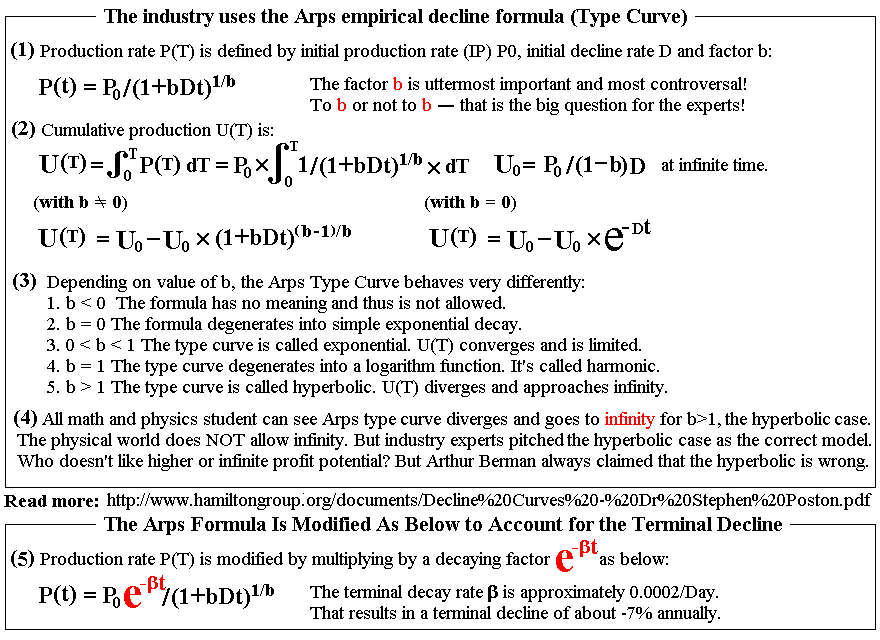
Traditionally natural gas (UNG) producers use the classical Arps formula to model a conventional oil or gas well's production decline.

As I discovered, and as many people pointed out, the classical Arps formula is not suitable for projecting shale well's decline patterns, as shale wells decline much faster than the formula projects in the long term. Specifically the terminal decline of Arps formula approaches zero, and the cumulative production it projects approaches infinity with a b-factor larger than 1.0. That's problematic, as in the long term, shale wells should decline a terminal decline rate above zero.

Let's re-cap about the classical Arps formula and how I modified it:

(click to enlarge)

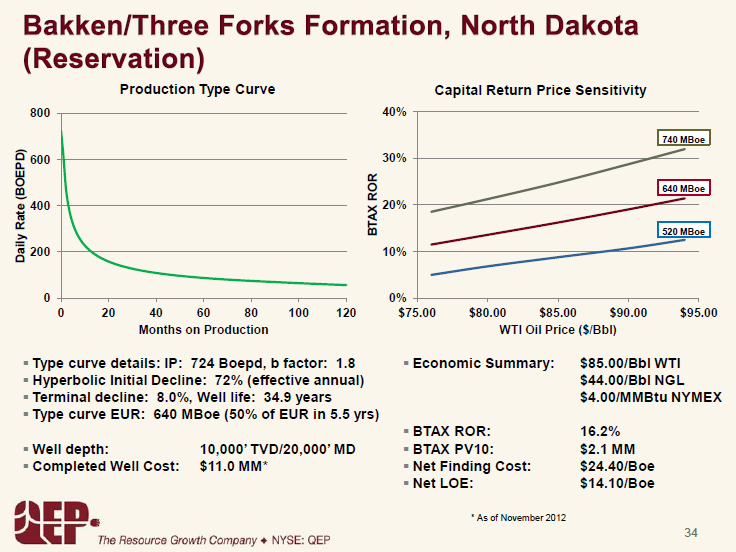
I am happy to find out that even though most producers insist on using the classical Arps formula, QEP does use the SAME modified Arps formula with a terminal decline term introduced. In that sense they agree with my own modeling method. I congratulate management of QEP for being a little bit more honest than Chesapeake (CHK) and Cabot Oil & Gas (COG).

But even QEP used the same correct modified Arps formula as I do, and admitted a reasonable terminal decline rate, they still pushed for a set of parameters that gave a higher EUR (Estimated Ultimate Recovery) than what is realistically possible.

Modeling Bakken Well No. 16637

I extracted monthly production data from ND DMR web site. I did the calculation on a spreadsheet. Here are the comparisons. Note that both QEP and I used the same formula with four parameters: IP, D, b-factor and terminal decline rate Beta. I just disagree with QEP on what parameters provide the best fit. Here is QEP's model:

(click to enlarge)

According to the chart, here are QEP's parameters, versus mine:

  • QEP adopts IP = 724 BPD, D = 0.0035/day, B = 1.80 and Terminal decline rate Beta = 0.000228/day
  • I adopt IP = 1250 BPD, D = 0.020/day, B = 1.80 and Terminal decline rate Beta = 0.000280/day.
Both QEP and I use the same b-factor of 1.80. I use slightly higher IP, slightly higher terminal decline rate beta. But the biggest difference is that QEP uses an extremely low initial decline rate, by the shale industry's standard. I think there is no justification for using such a low value of D. Shale wells decline extremely fast in the first few weeks. Other producer use a D ten times as higher.

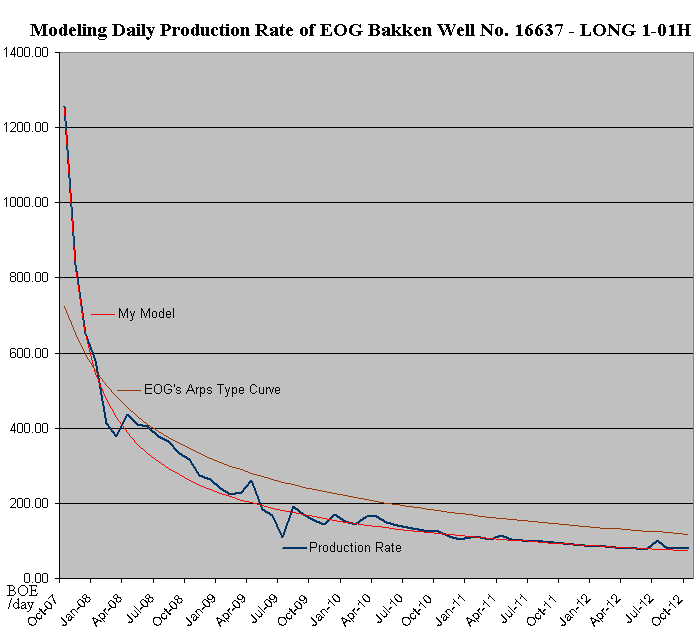
As I said, I agree with QEP in the formula used, I disagree with them in the specific fitting parameters. Let's see who fit the data better:

(click to enlarge)

It appears to me that my curve fit the actual production data much better. The QEP curve does not fit the well data very well.
My speculation is that they know that they need a flat curve to obtain a higher EUR value. The more flat the curve is, the higher EUR it will calculate. Thus they probably deliberately pull the IP down to a much lower starting point.

To compensate for a lower starting IP, they adopt a much smaller initial decline rate D, which makes the curve flatter.

Finally, to further flatten the curve, they tried to fit the artificial local peak of production, at April and May of 2008, which resulted from re-fracing operation (re-stimulation). I believe the cur should follow the non-disturbed natural decline trend, instead of following the artificial temporary boost of production, to be realistic.

The chart above shows that my curve following the real production down closely, while the QEP curve deviate on the higher side.

(click to enlarge)

The above chart, plotted in much longer time scale, and using logarithm scale, shows the deviation much better. Once again, my curve tracks the actual production data very closely. But the QEP curve clearly deviates from the real data and projects too high.
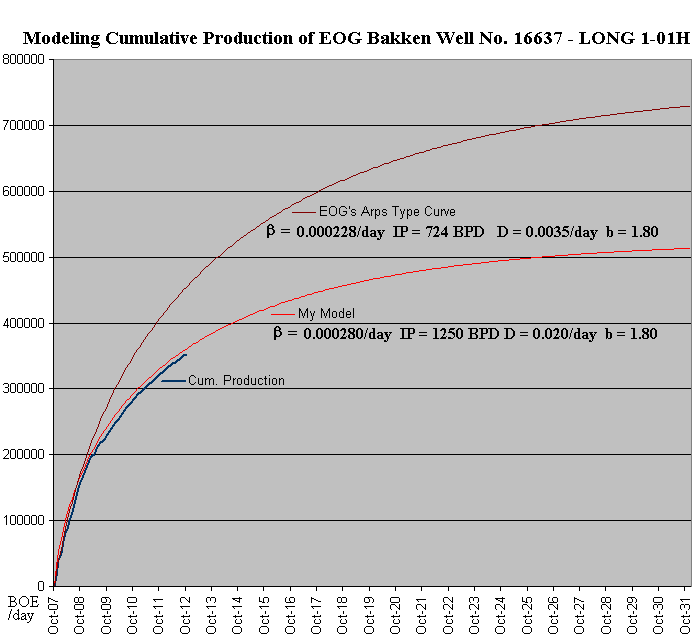
As a result, when you integrate the cumulative production over time, QEP's curve would over-estimate while my curve gives the accurate projection. See below:

(click to enlarge)

As shown above, my parameters leads to accurate projection of the actual production. The QEP curve clearly deviates on the high side.

I projected that the EIR of well No. 16637 will likely be 500 MBOE. The QEP projection is 750 MBOE. The chart clearly agrees with me.

Calculation and Discussion

As of now, the well 16637 is a bit more than five years old, and has produced an accumulative 355.280 MBOE. Current production rate is 80 BOE/day. Current annual decline rate is -16% to -22%. Using -18% annual decline, and using 10 BPD as cut off, the well will produce another 145 MBOE, bring the total EUR to 500 MBOE.
This well is NOT a typical or average Bakken shale well. If it is, even if the EUR is only at 500 MBOE, producers would make an incredible profit at $100/barrel oil price. Unfortunately that is not the case. The average Bakken shale well has a much lower IP and much lower EUR, even if they are equally cost to drill.
As of October 2012, there are 6349 producing Bakken shale wells. They collectively produced 821.30 MBOE/day. There are 6077 wells which were also producing in September, and 272 new wells which first show up in October. The 6077 wells producing in both months collectively declined from 790.33 MBOE/day to 715.820 MBOE/day from September to October, or -9.5%/month. That is a daily decline rate of /month, or -0.33%/day. At this decline rate, these well's future production will be equivalent to 1/0.33% = 303 days worth of production at current rate of 716 MBOE/day, or 217 million BOE. Divided by well numbers, each well has an average of 35.7 MBOE remaining production. That does not look like a lot of value to me. At $90/barrel, that's a remaining production value of $3.2M each.

Good luck drilling every well as productive as No. 16636, producers!

I repeatedly pointed out that shale oil and gas producers tend to over-exaggerate productivity of their wells, under-estimate the well declines, and under-calculate the fair capital amortization cost, in order to pitch their investment case to banks and investors, so they can keep borrowing more money to keep drilling shale wells.

In reality, even Bakken shale oil wells are hardly profitable at current oil prices and current development costs. My advice to investors is to do your own due diligence research and scrutinize the data. Avoid the hyped shale oil and gas sector. The sector you should get into, is the US coal mining sector. The meme that natural gas is replacing coal, is completely wrong. Natural gas will always be an important part of America's energy supply. But at fair cost, shale gas can not compete with the cheap king coal.
The investment case in coal is made better as nearly 99% of investors made the wrong bet, as there is 75 times more market capital invested in the NG sector than in the US coal sector, while both sectors contribute about equal energy to the US economy.

Imagine what happens when the looming debt crisis in the NG sector unfold, and shale gas production collapses, sending prices of both NG and coal much higher, and 75 more market capital in the NG sector now moves to coal sector instead. This is not an opportunity you get to see every year. Now is the best time to get into coal. I recommend these names: JRCC, ANR, ACI, BTU.

Friday, August 19, 2011

More On the Coming Palladium Paradigm Shift

In early December, 2010, I pointed that there will be a huge paradigm shift in the supply/demand of the global palladium and platinum market. Norilsk Nickel (NILSY.PK), the largest nickel mine in the world who is also responsible for 45% of the world's palladium and 10% of platinum, is abandoning the traditional pyrometallurgy process and adopting the more efficient Activox Process, hydrometallurgy that extracts base metals from mineral ores by chemical leaching. The change is necessary due to severe pollution and deteriorating ore grade.

Knowing the physics in mining, I saw something with hugely significance: While the new technology can extract nickel and copper at near 100% efficiency at low cost, it also means that the chemically stable PGM contents, platinum and palladium, will be extremely difficult to extract. Norilsk will cease to be a major supplier of palladium and platinum. The supply disruption will cause a panic in the global market, sending the price of palladium to the sky!!!

After my article was published, some folks raised some questions. I have done more research on this issue and collected more information. The more I looked at it the more I am convinced of the unescapable conclusion. I will summarize the important points here:

1. Will Norilsk Nickel switch to Activox Process if they could lose PGM revenue?

They have to switch! Maintaining status quo is not sustainable:

a. Due to heavy pollution thanks to the traditional pyrometallurgy, Norilsk City tops the world's most polluted places. 98% of the people are sick. There is not a single live tree within a 30 miles radius. The company is paying 2.6 times higher salary for mining workers, but still can not retain the workforce. If the cost is losing your heath and lose the ability to to raise heathy children, who would want to work in such a filthy place? The government would not turn a blind eye forever.

b. Pyrometallurgy is extremely energy intensive. Even though the technology can extract up to 70% of the base metals and palladium, higher energy cost and deteriorating ore grade means the process could become un-profitable, even if you don't consider the cost to the environment.

c. Activox Process consumes much less energy. The chemicals can be recycled and reused. Not to mention that it extracts nearly 100% of the base metals, versus 70% in pyrometallurgy. The lower cost, more efficient extraction of nickel and copper more than offset loss of PGM revenue.

d. All information indicates that Norilsk is making the switch. They paid US$6.5B cash to acquire LionOre to obtain the Activox Process technology, and rename it to Norilsk Process. They announced aggressive projects to improve mining process. They announced that beginning in 2013, the sulphur emission will be cut from nearly one million tons a year, to only 0.2 million. Such drastic pollution reduction can only happen with the switch to Activox.

Although in the same investor presentation, Norilsk projected continued palladium and platinum production at near flat level. Many readers quoted that report and criticized my conclusion. My response is that Norilsk did not develop the technology, it purchased it. The investor report was prepared by high level management who know very little of the actual physics in mining process. From their point of view, whatever is in the ore, they assume it can be extracted. Whatever technology that do not exist today to extract certain metal content, they assume will become available some years down the road. When making long term projections you are not encumbed by limitation of what is feasible today, but you aim for the long term goal. So I don't blame Norilsk for making the projection that they are going to continue to produce palladium. But the projection is too rosy. It is unrealistic.

But investors need to scrutinize what can or can not be done today or in the near future. We have to get to the intimate details to dig out the facts. With known physics, I do NOT see how they can continue to extract PGM metals once they switch to Activox.

2. Is it really impossible to extract PGM metals once Activox Process is adopted

We have to look at the basic physics of mining process. After mineral ores are collecetd from a mine, the first step, called milling, is to crush the materials into small particles so the rocks and the metal containing grains can then be separated. In traditional mining process, a technology with over a hundred years of history is used, called Froth Flotation. Let me explain it.

Different material stick to oil or other liquid differently. Some will soak in the liquid, some will form oil like droplets as they don't stick. Using this property, we can pour the crushed mineral grains into certain water solutions, and then blow bubbled from the bottom. The metal grains will more likely stick to the bubbles and be bought to the surface, while rock particles remain on the bottom. We can then skim off the top layer which contains metal rich concentrates. This process is called froth flotation.

Mining engineers will tell you that for effective froth flotation, the ores must be grinded to proper particle size. If it is grinded too coarsely, then the metals and rocks are still mixed in the same particles. But if it is over-grinded, it results in particles so tiny that they are almost equally likely to stick to the bubbles, thus it is unable to separate metal and non-metal content. The over-grinding is also called sliming.

How much grinding is over-grinding? This paper and many others suggest that roughly 30 to 80 microns is the ideal particle size for optimum froth flotation recovery. For particles 10 microns or less, the recovery rate quickly falls off.

Chemical leaching, like Activox Process, has a different grinding requirement. For effective leaching, the ores must be ultra fine grinded so as to thoroughly expose the metals to the chemical solution. Literatures on Activox, like this, and this, describe that the ores are grinded to 10 microns or less before feeding into the leach process.

Based on the flow chart, the PGM metals are left in the solid leach residue. The material is then send to a Froth Flotation process to attempt to extract the PGM particles. That was the original design intention. In the actual Tati Nickel demostration plant, the PGM flotation unit was never actually built to test the feasibility of this extra PGM extraction step.

In Norilsk ores, 99.98% of the metal content is nickel and copper. Platinum and palladium is only 0.02%. Starting with 10 microns metal particles, going through chemical leaching which dis-solves 99.98% of the nickel and copper, there is just a tiny bit of the original metal particles remaining. I calculated the resulting PGM particles will be less than 0.6 microns in diameter.

The 0.6 microns number assumes that during the chemical leaching, metal particles do not break down into bits, but remain whole grains. Most likely the particles do break into bits, thus the PGM content probably will become such tiny dusts that they are simply lost within the leach waste. It's just not possibel to recover anything through the conventional froth flotation method, which requires 30 to 120 microns particles. There is no other known technology to pick up such metal dusts efficiently from the waste material.

So the inevitable conclusion, based on physics, is: Norilsk Nickel can NOT produce platinum and palladium any more once they move towards Activox. But they must switch over to the process!

3. How do you leverage the opportunity?

Buy any palladium coins or metal bars you can find; Purchase the PALL and PPLT, which are ETFs backed by physical palladium and platinum metals. But more attractive is to buy shares of the world's only primary palladium producers: Stillwater Mining (SWC) and North American Palladium (PAL).

I encourage metals analysts, and experts from major PGM metal industry users, to really look into this looming palladium supply issue, and consult mining experts to verify my conclusion.

Disclosure: The author is heavily invested in palladium and in stocks of SWC and PAL.

Thursday, August 11, 2011

How Fast Can The US Dollar Collapse?

Recent volatile and relentless surging gold price suggests that we are getting closer to the catastrophic collapse of the US dollar and other likewise fiat currencies of the world.


Remember, no matter how high gold price goes up, it is not the value of gold that's going up, it is the value of the dollar that's going down. Gold is just a commodity that happen to be commonly used as money. Gold does not pay interest or generate income. Gold has no investment value but has storage value. No matter how high gold price goes up, you are not going to be able to buy more stuff with gold, but you merely avoided the loss of value holding ever depreciating dollar.


How fast can the US dollar collapse is the same question as asking how fast can the gold price go up, in dollar terms. Let me try to come up with a model.


The gold price can be written in the following generic formula, which is always correct as long as you choose the proper time dependent function Y(T):


P = P0 * exp(Y(T))


The price of gold should increase or decrease in exponential terms. No matter where the price is, the change is alway in percentages, i.e., the change is reflected in the exponent Y(T). As time elapses, Y(T) increases over time, giving an ever increasing exponent and ever increasing gold price. So let's look at what Y(T) should look like.


In the constant inflation scenary, gold price should increase the same percentage each year, therefore Y(T) would simply be proportional to the time, t, Y(T) = C*T.


But we are not talking about constant inflation. The scenary looks like at first, there is almost no inflation. And then as inflation slowly kicks in, the problem becomes more and more serious, and they print more and more money to spend. Therefore, the higher the inflation pace, the more money they print, and the more money they print, the higher the inflation will go up. It all starts with almost no inflation, and ends with inflation approaching infinity.


In mathematics we can write such correlation simply as that the derivative of Y(T) is directly proportion to Y(T) itself:


dY(T)/dt = C * Y(T)


If you are familiar with math you immediately recognize what it is. It is the exponential function:


Y(T) = EXP(C*(T-T0))


Thus we obtain an elegant math formula of gold price, once you plug in the Y(T):


P = P0 * exp(exp(C*(T-T0)))


Let's pick the two constants. The current gold bull market starts in the beginning of year 2000. Let's use year for the variable T. T0 = 2000. For example today, August 11, 2011 is the 223th day of the year. So for today, T = 2011 + (223/365) = 2011.611


Let's use $200 as starting gold price at the beginning of 2000. That would require that


P = P0 * exp(exp(0)) = $200


Therefore P0 = $200/exp(1) = $73.5


I find that using the constant C = 0.1 gives a perfect gold price match for the past 10 years:


P = $73.50 * exp(exp(0.1*(T-2000)))


For today, T = 2011.611, the formula will give $1791. That's right where we are right now today on the gold price!


Hold your breath. And now, the following chart shows how good this elegant formula matches up with the past eleven years of gold price, and what the future trend will be!


Folks, you still have some time, but clearly time is quickly running out before hyperinflation kicks in in full power. Buy physical precious metals now: Gold, silver, platinum and my favorite, palladium! Buy precious metal and commodity mining stocks: SWC, PAL, PCX, SSRI, CDE, JRCC, PAAS. These are the only things that can protect you in the coming years!

Saturday, July 9, 2011

White Gold, Black Gold and China's Energy Crisis

China has a looming energy crisis. There is a severe, ongoing electricity power shortage throughout most area of China since spring time this year. The power shortage occured long before the summer peak power consumption season kicks in. Mean while, city residents complain about high food prices while tearful farmers had to destroy their harvest corps of vegetables and bananas, because no one is buying their food produces even at dirt cheap give away price of a few cents per pound. The reason: even though the prices of produces may be dirt cheap where they are harvested, the cost of transportating them and distribute them into the basket of city dwellers is no way cheap at all. The transportation bottleneck in China is just another facet of the energy crisis in China: There are not enough truck and diesel fuel to transport the good around the country, because diesel fuel is also needed to generate electricity.

China is a huge country with close to 1.4 billion people. The world population is now approaching the 7 billion mark. The rapid economic development in China and in other emerging market means a lot more energy is consumed to produce and transport all the goods and foods to feed the world's population. But we are quickly approaching the limit of how much planet earth can supply to feed the population of this world, both in terms of fossil fuels, and in terms of other natural resources.

The reality of limit of growth is one that every investor needs to reckon with. The goal of any investment is the growth of fortune. Economists believe that sustainable growth is always possible given enough incentive of demands. But in a limited world, sustainable growth is not possible. How do individual investor grow his/her share of the fortune, when there is a limit of growth for the world as a whole? A while ago I pointed out thet fact that the most successful investor in the world, Mr. Warren Buffett, actually saw his fortune SHRUNK by 75%, in teh last 13 years, in real valuation term. It should make you pause and think about: Why Mr. Buffett could not grow his fortune in the last 13 years. What chance do we the small popatos have, in beating Warren Buffett and do much better than him in growing our investment fortune?

Great investment opportunities can be discovered if you recognize how resource constraints are limiting the growth of China and other emerging markets. Let's look at some numbers in China's on going power shortage. According to BP World Energy Review 2011: China produces and consumes more than half of the world's coal in 2011: China produced 1800.4 MTOE (million tons of oil equivalent) of coal out of the world's 3731.4 MTOE, and consumed about as much. One ton of coal in average is equivalent to 0.55 tons of oil in energy content. So in real tonnage, China produced and consumed 3.3 billion tons of coal per year. That number had been increasing annually at 10% pace in recent years!

China's domestic coal production simply could not catch up with demand growing at such a pace. It has to turn towards importation. China only begin to import significant amount of coal in 2009. By 2010 the net coal import reached 150 million tons. The staggering growth is sure to continue in 2011, to 233 million tons according to Citigroup.

This year China faces a power shortage of 30G, or even 40G watts. In average it costs roughly 0.55 kilograms of coal to generate one kilowatt-hour of electricity. So 30GW shortage means a need of an extra 145 million tons of coal per year to fill the gap. That's more than the amount of coal burned by ESKOM in South Africa to generate electricity!!!

But look at the world's major coal exporters you have to wonder where can China get its coal in the next few years. The total global coal export is only roughly 1 billion tons per year. At 3.3 billion tons per year basis, one year of China's demand growth at 10% pace is big enough to consume 1/3 of the world's total available exports. The world doesn't have any spare coal export to meet China's growing demand, unless major coal producers drastically ramp up their production and exportation.

Don't forget India, a developing economy with a population that is about to exceed China, and one which is growing almost as fast as China. India also has an insatiable appetite for coal. It is also facing a severe domestic coal shortage and is looking around the world for coal. India produces 400 million tons of coal per year but consumes 555 million tons, numbers that are much lower than China's, meaning a much bigger potential for demand growth. The Indians are traveling around the world to sign coal contracts just as the Chinese do. So where can the Indians and the Chinese find extra coal supply?

Let's turn attention to South Africa, the only place that foreign importers can hope to buy more. According to a recent report on the operation of ESKOM, south Africa's national electricity company, they buy domestic coal at prices much lower than international market price, and collect electricity revenue at electricity prices much cheaper than any other countries. In last year, ESKOM burned 125 million tons of coal, paid 35.8 billion rands for the fuel and collected 91 billion rands from electricity tariffs. Using 0.55 kilogram of coal per kilowatt-hour electricity, and one US dollar equals to 6.70 rands, I calculated that ESKOM is paying less than $43 per ton of coal, and South Africa is paying an average of US$0.06 per kwh of electricity. Actually the subsidized big industry is paying way much less, at about 0.25 rands per kwh, or 3.73 US cents.

The coal price ESKOM is paying is not competitive against potential international importers, who are now paying more than US$120 per ton just to load South African coal into ships waiting at the harbors. The country has such a crumbling electricity supply infrastructure that this year, before the arrival of the winter season, which is July in the southern hemisphere, ESKOM could not afford to shut down the power generators for routine maintenance on a rotational basis.

With ESKOM's power generators working overtime without proper maintenance, burning lowest quality coal that frequently clogs up the equipments, and more over they probably will not be able to get supply of even such lowest quality coal for much longer because the Indian and the Chinese importers are eager to pay a much higher price to buy lower quality coal, how long will it be before the country's electricity grid crumble down once more, triggering a panic rally of prices of precious metals platinum and palladium like in early 2008? South Africa is the world's major producer of PGM metals, producing 85% of the world's platinum and 40% of palladium.

Mining and production of PGM metals is extremely energy intensive. According to data from major platinum producers, it costs roughly 1x10^10 joules of energy, or 2778 kwh of electricity to produce just one troy ounce of PGM metals. That's only direct energy cost. Count in exploration and development of mines, mining equipments, and labor cost etc, the total direct and indirect energy cost could be 5 times higher at 13890 kwh. If fair cost of energy is US$0.15 per kwh, then the fair cost of PGM metals should be at least $2100 per ounce.

So the best way to leverage on China's energy crisis due to shortage of the black gold, the coal, is surprisingly in metals that South Africa produces: the white gold, platinum and palladium. Coal shortage means platinum and palladium shortage one way or another: Either South Africa keeps price of its electricity low and it leads to a crumling electricity grid which collapses the country's PGM mining industry, or ESKOM has to pay fair market price for coal and charge big industry fair electricity cost, bringing the PGM mining industry out of business unless they ask for much higher prices for platinum and palladium.

How to play platinum and palladium? Buy the physical precious metal, or the physcial metal backed ETFs, PPLT and PALL. As for mining companies, I would not recommend South Africa based PGM mining companies: they are restrainted by the country's electricity grid. Instead you should look in North America: Stillwater Mining (SWC) and North American Palladium (PAL) are the world's only primary palladium producers. Located in North American and being the world's only PGM producers with the capacity to grow production, they are best positioned to take advatnage of a situation created by China, India and South Africa.